

You know the feeling: Someone asks for a favor, or a situation feels unfair, and you freeze. You know what you want to say. You know what is fair. Yet, the words get stuck in your throat. You might nod "yes" while your stomach turns, or you might stay silent, hoping the problem goes away.
In therapy, we often see clients who hold back their true needs to "keep the peace." But eventually, that silence comes at a cost. It often manifests as resentment, burnout, or even physical symptoms like sleep disruption—waking up at 5:00 AM with a racing heart because of unexpressed frustration.
If this sounds familiar, you aren’t alone. The good news is that setting boundaries is a skill you can learn. Using principles from Cognitive Behavioral Therapy (CBT) and Solution-Focused Brief Therapy (SFBT), you can learn to communicate clearly, kindly, and firmly.
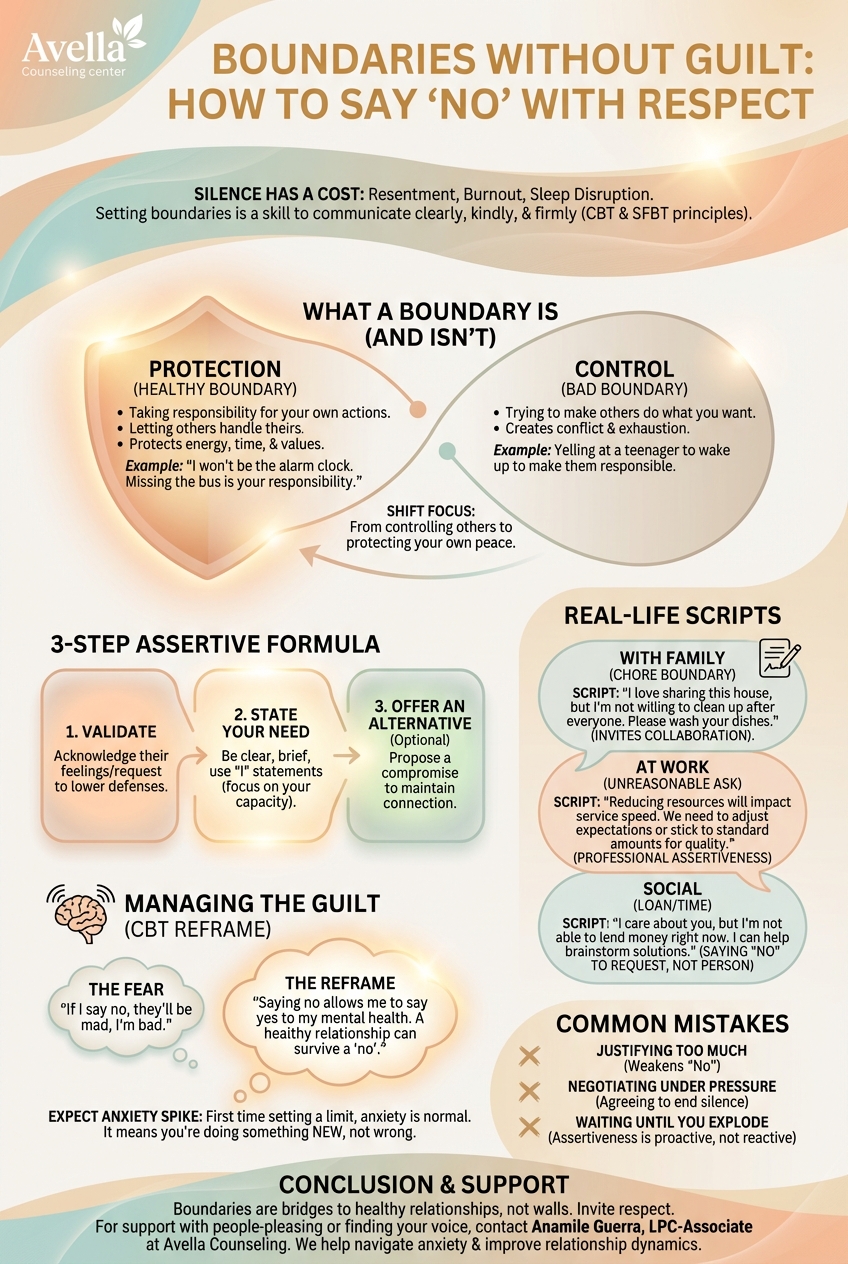
What a Boundary Is (and What It Isn’t)
Before we talk about how to set a boundary, we need to define what it is. A boundary is simply a line that protects your energy, time, and values.
To understand this better, it helps to distinguish between control and protection:
- Control (A Bad Boundary): Trying to make others do what you want.
- Example: Yelling at a teenager to wake up every morning because you want them to be responsible. This is exhausting for you and creates conflict.
- Protection (A Healthy Boundary): Taking responsibility for your own actions and letting others handle theirs.
- Example: Informing the teenager, "I love you, but I’m done being the alarm clock. I won’t be waking you up anymore. If you miss the bus, it will be your responsibility to resolve it."
See the difference? The second option removes the need for nagging and shifts the focus from controlling the other person to protecting your own peace.
The 3-Step Formula for Assertive Communication
When you are ready to speak up, you don't need a long speech. In fact, fewer words are often better. Here is a simple 3-step formula we often use in communication skills training:
- Validate: Acknowledge the other person’s request or feelings. This lowers their defenses.
- State Your Need: Be clear, brief, and use "I" statements (focus on your capacity, not their flaws).
- Offer an Alternative (Optional): If you want to maintain the connection, offer a compromise.
Scripts for Real-Life Scenarios
It helps to have a plan before you speak. Here are practical scripts for common stressful situations, similar to those we practice in therapy sessions.
With Family (The "Chore" Boundary)
Living with family often leads to blurred lines regarding housework. You might feel resentment building when you come home to a messy kitchen.
- The Script: "I noticed the dishes were left on the table. I love sharing this house with you, but I’m not willing to clean up after everyone anymore. Please wash your dishes so we can keep the kitchen nice for both of us."
- Why it works: It’s polite but firm. It invites collaboration rather than starting a fight.
At Work (The "Unreasonable Ask" Boundary)
Fear of authority often keeps us silent at work, but silence can lead to burnout.
- The Script: "I understand we need to cut costs/time, but reducing the resources this much will impact our service speed tonight. I can make this work if we adjust expectations on wait times; otherwise, I believe we need to stick to the standard amount to ensure quality."
- Why it works: This is professional assertiveness. As seen in stress management counseling, employees who speak up with logic and solutions are often respected more, not less, by their management.
Social Situations (The "Loan" or "Time" Boundary)
A friend asks for money you can't lend, or time you don't have.
- The Script: "I care about you, but I’m not able to lend money right now. I can help you brainstorm other solutions, though."
- Why it works: You are saying "no" to the request, not the person.
Managing the Guilt and the "What Will They Say?" Fear
The biggest hurdle to setting boundaries isn’t not knowing what to say—it’s the guilt that follows.
This is where Cognitive Behavioral Therapy (CBT) helps. We look at the thought behind the guilt.
- The Fear: "If I say no, they will be mad, and I’m a bad person."
- The Reframe: "Saying no to this request allows me to say yes to my own mental health. A healthy relationship can survive a 'no'."
Expect the Anxiety Spike:
The first time you set a limit—like telling a family member you won't cover for them—your anxiety will likely spike. This is normal. It doesn't mean you did something wrong; it just means you are doing something new.
As you practice, you will likely find that the catastrophic reaction you feared doesn't happen. In fact, many people report feeling a sense of relief and increased respect from others once the initial awkwardness passes.
Common Mistakes When Setting Boundaries
- Justifying too much: "I can't come because my cat is sick, and I have a headache, and…" Stop. Giving a 5-minute explanation weakens your "No" and gives the other person room to argue.
- Negotiating under pressure: Agreeing just to end the awkward silence. It is okay to say, "Let me think about that and get back to you."
- Waiting until you explode: If you wait until you are furious to set a boundary, it will come out as aggression. Assertiveness is proactive, not reactive.
Mini-Exercise: Strengthen Your "No" Muscle
You don't have to start with the biggest conflict in your life. Start small.
- Write down 3 boundaries you need to set this week (e.g., leaving work exactly on time, asking a child to handle a specific task, declining a social invite).
- Practice saying the script out loud in front of a mirror.
- Visualize the conversation going well.
Conclusion
Boundaries are the bridge to healthy relationships, not walls that shut people out. When you communicate your needs clearly, you are actually inviting the other person to treat you with the respect you deserve.
If you struggle with people-pleasing, anxiety around confrontation, or finding your voice, you don't have to figure it out alone. Therapy can provide a safe space to practice these scripts and uncover the root of your guilt.
If you are ready to start building healthier relationships, contact Anamile Guerra, LPC-Associate at Avella Counseling. We are here to help you navigate anxiety and improve your relationship dynamics.
References & Further Reading: