
You are the pillar of your family. You are likely a leader in your church or the person your friends call when their world falls apart. You organize the events, you manage the crises, and you make sure everyone else is fed and happy. You pride yourself on your resilience.
Perhaps you even think of yourself as having an "emotional six-pack." You feel trained to handle heavy loads, believing that while others might crumble under pressure, you are built to withstand it.
But lately, that strength feels less like a badge of honor and more like a heavy shield. You might find yourself saying, "I'm strong, but I'm tired."
In my practice in Pearland, I work with many capable, high-achieving women who feel guilty the moment they sit down. This article explores high-functioning anxiety, the hidden cost of being "the strong one," and how to move from exhausting self-reliance to sustainable self-care.
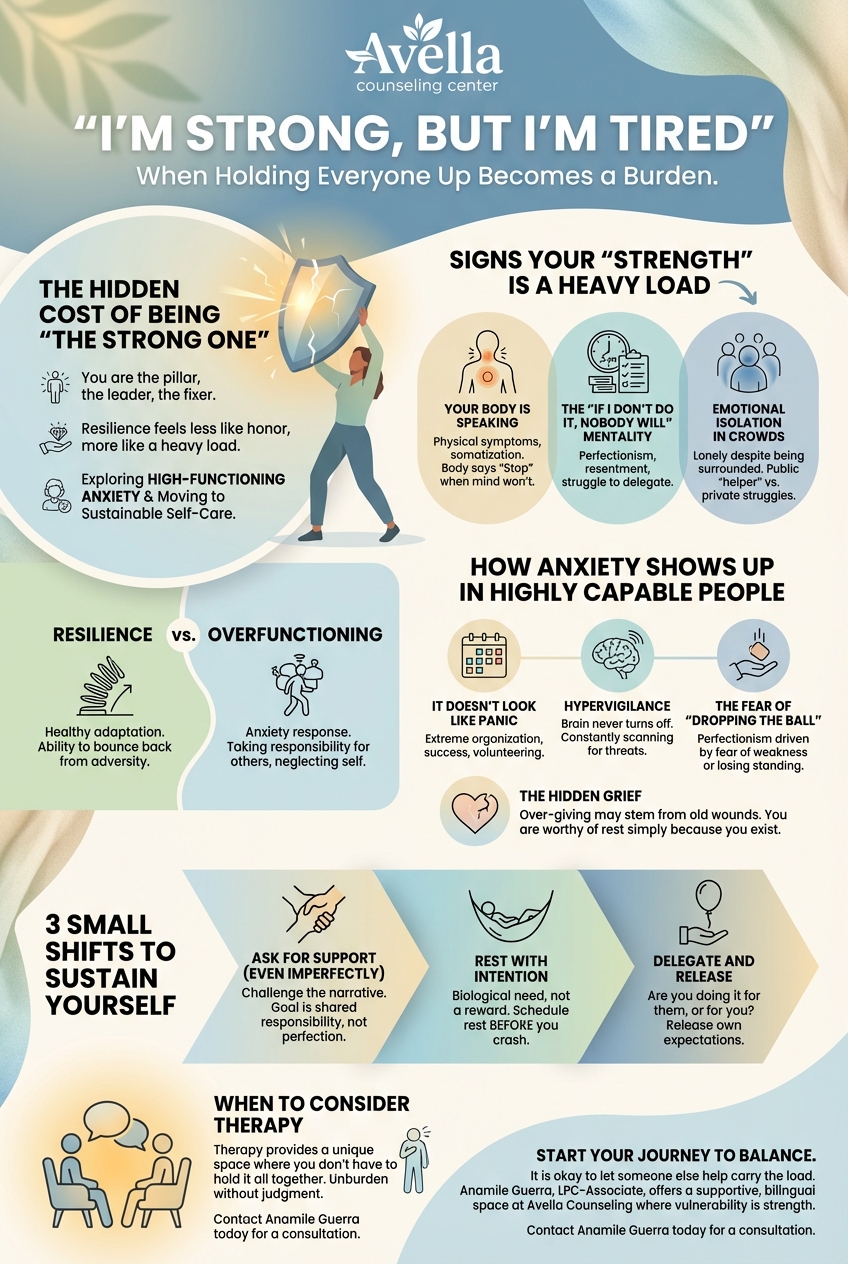
Signs Your “Strength” Has Become a Heavy Load
Many people who identify as "the strong one" ignore their emotional needs until their bodies force them to pay attention. When you suppress stress to keep functioning, your body often keeps the score.
- Your Body is Speaking for You: Do you frequently lose your voice, suffer from throat issues, or experience sudden shortness of breath? Do your feet or back ache not just from movement, but from tension? Somatization is when emotional distress shows up as physical symptoms. It is your body’s way of saying "Stop" when your mind refuses to.
- The "If I Don't Do It, Nobody Will" Mentality: You might find yourself staying up until 3:00 AM ironing tablecloths or finishing a project because you believe that if you delegate it, it won't be done "right." You may feel resentment that others just show up as guests in their own lives while you do all the work, yet you struggle to let them help.
- Emotional Isolation in Crowds: You are surrounded by family, congregants, or colleagues, yet you feel lonely. This happens because while everyone knows the "public you" (the helper, the leader), very few people know your internal struggles, such as financial worries or past wounds.
The Difference Between Resilience and Overfunctioning
There is a fine line between being resilient and overfunctioning.
Resilience is the ability to bounce back from adversity. It is a healthy adaptation.
Overfunctioning is an anxiety response. It involves taking responsibility for others' emotions, problems, and duties to the point where you neglect yourself.
For many, this starts as a survival mechanism. If you grew up navigating financial hardship, migration stress, or a chaotic home environment, you likely learned that being "perfect" and "in control" was the only way to stay safe. You might hide debts, struggles, or sadness because you feel your role is to protect the image of stability for everyone else. While this served you in the past, carrying this survival mode into the present can lead to burnout.
How Anxiety Shows Up in Highly Capable People
When we think of anxiety, we often picture someone having a panic attack. However, high-functioning anxiety often looks like extreme organization and success.
- It Doesn't Look Like Panic: It looks like color-coded calendars, hosting perfect events, and being the first to volunteer.
- Hypervigilance: Your brain may never truly turn off. You might find yourself constantly scanning for threats—worrying excessively about your children driving in the rain, stressing over legal or immigration uncertainties, or replaying financial scenarios in the middle of the night.
- The Fear of "Dropping the Ball": You may believe that one mistake will ruin everything. This perfectionism is often driven by a fear that if you show weakness, you will lose your standing or your safety.
The Hidden Grief of the Strong Woman
Beneath the busyness, there is often a quiet grief. Many "strong women" have complex histories with their own families of origin. You may be pouring endlessly into your children or community in an attempt to give the love and care you wished you had received from your own mother or father.
Recognizing that your drive to over-give may stem from an old wound is a powerful step toward healing. It allows you to see that you are worthy of rest simply because you exist, not because of how much you do for others.
3 Small Shifts to Sustain Yourself Without Feeling Like You Failed
You do not have to stop being strong to start being healthy. Here are three shifts to help you find balance.
1. Ask for Support (Even Imperfect Support)
Challenge the narrative that you are the only one who can handle things. If you ask for help and it isn't done exactly how you would do it, try to let it go. The goal is not perfection; the goal is shared responsibility.
2. Rest with Intention
Rest is a biological need, not a reward for finishing your to-do list. Many strong people only rest when they crash from sickness. Try to schedule rest before your body forces you to.
3. Delegate and Release
Sometimes we hold onto tasks because we want to feel needed or appreciated. If family members aren't helping with an event you are organizing, ask yourself: Am I doing this for them, or is this for me? As a wise daughter might tell her mother, sometimes the pressure we feel comes from our own expectations, not the demands of others.
Brief Exercise: “What part of me needs help today?”
Take five minutes to journal on this prompt:
- What is one area where I am overfunctioning right now?
- What is one specific, small way I can ask for help with this task this week?
When to Consider Therapy
If you feel you can no longer rest, if you are isolating emotionally despite being social, or if you live in a constant state of "alert," therapy may be a helpful resource.
Therapy isn't just for "fixing" a crisis. For the strong person, therapy provides a unique space: it is perhaps the only place in your week where you do not have to hold it all together. It is a space to unburden the weight of secrets, family stress, or past grief without fear of judgment.
Talking about your worries—whether they are about finances, family dynamics, or deep-seated fears—can physically lower the pressure you feel in your chest and throat. You don't have to trade your strength for peace. You can have both.
Start Your Journey to Balance
You have spent a lifetime carrying others. It is okay to let someone else help carry the load for a while.
If you are ready to explore who you are outside of all the things you do for others, I invite you to contact me. Anamile Guerra, LPC-Associate, offers a supportive, bilingual space at Avella Counseling where your vulnerability is viewed as a strength, not a weakness.
Contact Anamile Guerra today to schedule a consultation.
Learn More About Managing Stress and Anxiety:
- How Anxiety Shows Up in Your Body
- Setting Boundaries Without Guilt
- Coping with Immigration or Legal Uncertainty
- External Resource: Understanding High-Functioning Anxiety (Psychology Today)
- External Resource: The Physical Impact of Stress (NAMI)
Disclaimer: This blog post is for educational purposes only and does not constitute medical or psychological advice. Therapy outcomes vary by individual.