
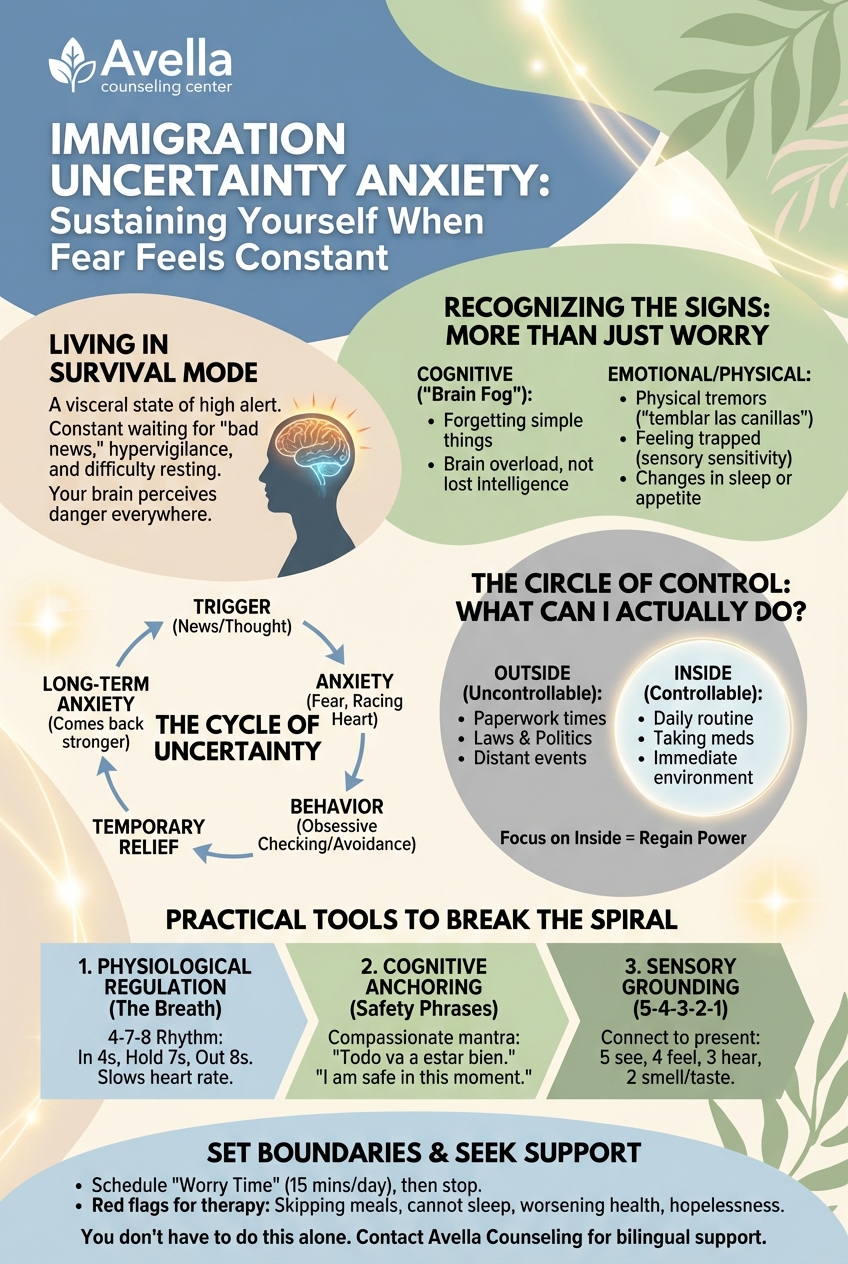
For many individuals and families, anxiety isn't just a fleeting feeling of nervousness—it is a visceral, daily survival mode. When you are living with uncertain legal status, or when you are separated from loved ones who remain in your home country, your body often stays in a state of high alert.
You might find yourself constantly waiting for the "bad news" phone call. You might feel an itch under your skin that won’t go away, a shaking in your legs, or a sudden urge to cry without a specific trigger. This is often referred to as immigration anxiety or migratory stress. It creates a state of hypervigilance where your brain perceives danger everywhere, making it difficult to rest, eat, or focus.
While we cannot change legal systems or processing times overnight, we can change how we respond to this fear. By using tools from Cognitive Behavioral Therapy (CBT) and solution-focused techniques, you can learn to sustain yourself and find pockets of peace, even in the middle of uncertainty.
Recognizing the Signs: It’s More Than Just Worry
When you are carrying the weight of family separation or deportation fears, your body and mind eventually become exhausted. It is important to recognize that these symptoms are not "personality flaws"—they are normal reactions to abnormal levels of stress.
Cognitive Signs: The "Brain Fog"
Have you noticed that you are forgetting simple things lately? Perhaps you walk into a room and forget why you are there, or you leave a pot on the stove and forget to turn it off until you smell it burning.
This is often called "brain fog." When your brain is constantly scanning for danger (fear of police, fear of letters in the mail), it uses up all its energy. It doesn't have enough "bandwidth" left for daily tasks. You aren't losing your intelligence; your brain is simply overloaded.
Emotional and Physical Signs
Anxiety often shows up physically before we even realize we are worried. You might experience:
- Physical tremors: Shaking hands or legs ("temblar las canillas") when you try to relax.
- Sensory sensitivity: Feeling like you are suffocating in small spaces, like a bathroom or a small office, because your body feels "trapped."
- Changes in basic needs: Eating only once a day because your stomach is in knots, or being unable to sleep because your mind races the moment you lie down.
The Cycle of Uncertainty
In therapy, we often look at the "loop" of anxiety. It usually looks like this:
- Trigger: You see a news report about deportations or have a thought about a family member back home.
- Anxiety: Your heart races, and you feel fear.
- Behavior: You try to fix the feeling. You might obsessively check the news, call your family repeatedly to make sure they are safe, or completely avoid leaving the house.
- Temporary Relief: You feel better for a moment because you "did something."
- Long-term Anxiety: The relief fades, and the anxiety comes back stronger, demanding you check again.
Breaking this cycle requires us to stop reacting to every fear as if it is an immediate emergency.
The "Circle of Control": What Can I Actually Do?
One of the most effective ways to manage this specific type of stress is to separate your worries into two categories using the Circle of Control.
Outside the Circle (Things You Cannot Control):
- How long immigration paperwork takes to process.
- Global politics or laws changing.
- The actions of distant relatives or dangerous groups in your home country.
- The past choices of family members.
Inside the Circle (Things You Can Control):
- Your daily routine: Getting out of bed, showering, and dressing.
- Your health: Taking your medications for diabetes, blood pressure, or other conditions on time.
- Your immediate environment: Spending time on your patio, tending to your plants, or caring for your pets.
Focusing on the "Inside" circle helps ground you. When you focus on the "Outside," you likely feel helpless. When you focus on the "Inside," you regain your power.
Practical Tools to Break the Spiral
When the panic rises—when your hands start shaking or you feel that urge to flee—try these stress management techniques.
1. Physiological Regulation (The Breath)
Anxiety tells your nervous system you are in danger. Deep breathing tells it you are safe.
- Technique: Inhale slowly through your nose for 4 seconds. Hold the breath for 7 seconds. Exhale slowly through your mouth (like you are blowing out a candle) for 8 seconds.
- Why it works: This specific rhythm physically forces your heart rate to slow down.
2. Cognitive Anchoring (Safety Phrases)
Your mind might be screaming, "Something bad is going to happen." You need a compassionate mantra to answer back.
- Try saying: "Todo va a estar bien" (Everything will be okay) or "I am safe in this moment. My family is safe in this moment."
3. Sensory Grounding
If you feel overwhelmed or "floaty," use your five senses to come back to the present. This is excellent for stopping panic attacks.
- Look: Find 5 things you can see (e.g., the trees outside, your dog playing).
- Touch: Find 4 things you can feel (e.g., the texture of your chair, the wind on your face).
- Listen: Find 3 sounds (e.g., music, birds chirping).
- Smell/Taste: Find 2 things you can smell or 1 thing you can taste.
Connecting with simple pleasures, like listening to music or watching your pets play, is not "wasting time." It is essential medicine for your nervous system.
Setting Boundaries with the News and Reality
Constantly watching news about immigration raids or violence can re-traumatize you. This is often called "doom-scrolling." According to the American Psychological Association, exposure to negative news can exacerbate symptoms of anxiety and trauma in immigrant populations.
The Strategy:
- Schedule "Worry Time": Allow yourself 15 minutes a day to check the news. Once the time is up, close the app or turn off the TV.
- Family Boundaries: It is wonderful to stay connected via video calls. However, if family conflicts or financial pressures from back home are adding to your illness, it is valid to set boundaries. You cannot help them if your own health collapses.
When to Seek Professional Support
It is common in many cultures to believe that seeking therapy is only for those who are "crazy." This is a myth. Therapy is for anyone carrying a load that has become too heavy to carry alone.
Red flags that indicate you may need support:
- You are skipping meals or have lost your appetite.
- You cannot sleep, or you sleep all day to avoid reality.
- Your physical health conditions (like diabetes or high blood pressure) are worsening due to stress.
- You feel a sense of hopelessness that won't lift.
Organizations like the Anxiety & Depression Association of America (ADAA) note that Generalized Anxiety Disorder (GAD) is highly treatable, yet many suffer in silence due to stigma.
You Don't Have to Do This Alone
You cannot control the future, and you cannot control the legal system. But you can control how you treat yourself today. If you are experiencing shaking, memory loss, or constant fear, you deserve support.
I am Anamile Guerra, a Licensed Professional Counselor Associate at Avella Counseling. I offer bilingual (English/Spanish) therapy to help you navigate these uncertain times with dignity and strength.
Ready to find your ground again?
Contact Avella Counseling today to schedule a session. Let’s work together to help you breathe easier.