

Do you ever feel like your mind is running a marathon while your body is just trying to keep up?
For many of us, the "to-do" list feels like a monster that never sleeps. You wake up already calculating the minutes until you have to leave the house. You drive while planning dinner. You cook while checking emails. This isn't just "being busy"—it is a nervous system state often called "hurry sickness" or living on autopilot.
In therapy, I often hear clients describe a paradox: they are rushing to get everything done perfectly, but the faster they go, the more clumsy mistakes they make. They lock their keys in the car, forget the permission slip, or snap at their children over small things.
If you feel like your "off switch" is broken, this article is for you. We are going to explore how to move from constant urgency to a pace that is practical, sustainable, and kind to your mind.
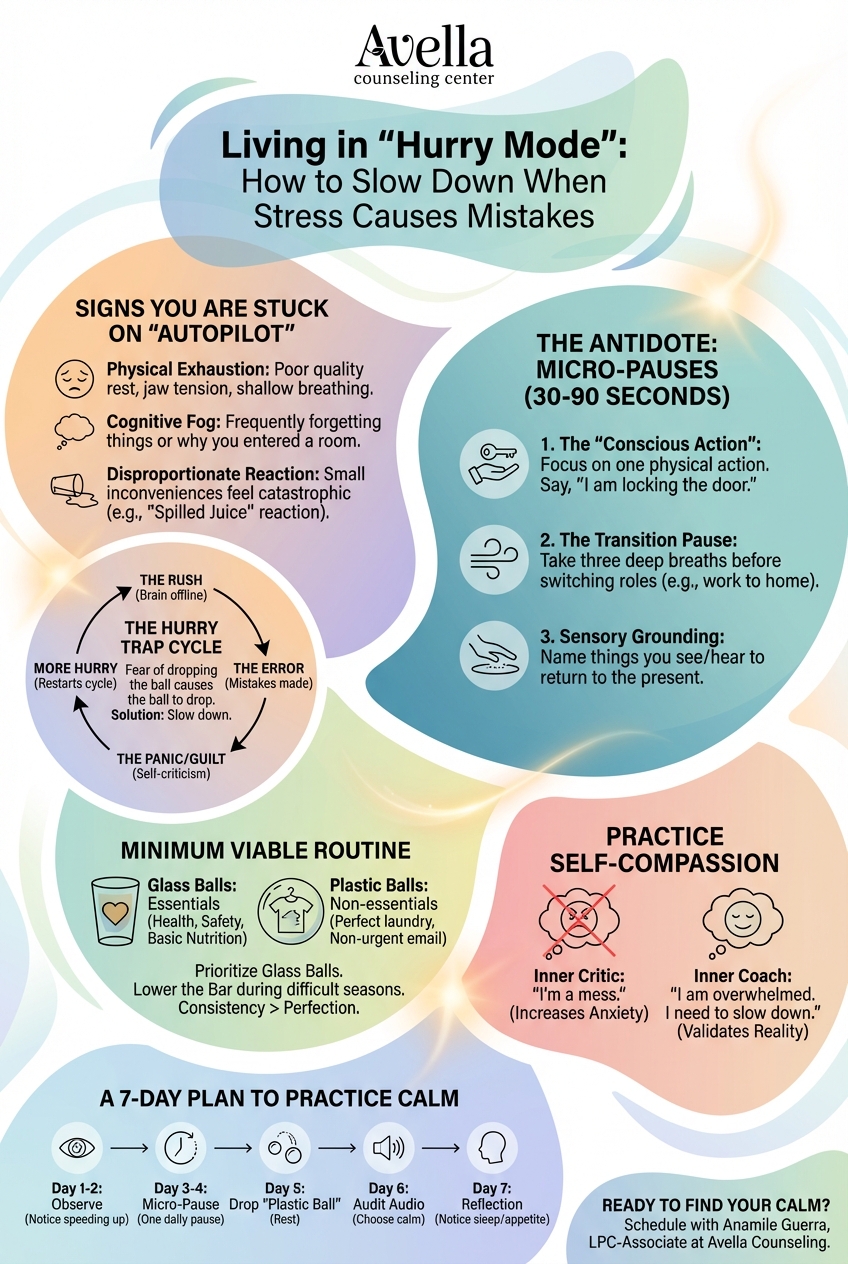
Signs You Are Stuck on "Autopilot" (It’s More Than Just Being Busy)
Autopilot is a survival mechanism. It helps us drive home without thinking about every turn. But when we get stuck there, we lose connection to the present moment. We stop living our lives and start simply processing them.
Here are common signs that your body and mind are stuck in urgency mode:
- Physical Exhaustion: You might wake up feeling tired even after a full night's sleep because your quality of rest is poor due to high cortisol levels. You might notice jaw tension or shallow breathing.
- Cognitive Fog: You frequently forget where you put things. You might walk into a room and forget why you are there.
- The "Spilled Juice" Reaction: This is a classic indicator. When you are calm, a child spilling juice is just a mess to clean up. When you are in "hurry mode," that same spill feels like a catastrophe that leads to yelling or tears.
If your emotional reaction to a small inconvenience feels disproportionate to the event, it is often a sign that your stress baseline is too high.
The Cycle: Hurry → Error → Guilt → More Hurry
Why does rushing actually make us less productive?
When we are stressed, our brain prioritizes survival functions over "executive functions" (planning, focus, and memory). Effectively, the part of your brain responsible for logic goes offline.
Here is the trap:
- The Rush: You rush to unload groceries while managing the kids.
- The Error: Because your brain isn't present, you make a mistake—like locking your keys inside the house or leaving your wallet at the store.
- The Panic: You criticize yourself ("How could I be so stupid?", "I don't have time for this!").
- The Reaction: To "fix" the lost time, you try to go even faster, which only restarts the cycle.
In therapy, we often see that the fear of dropping the ball is exactly what causes the ball to drop. The solution is counterintuitive: to stop making mistakes, you don't need to try harder; you need to slow down.
The Antidote: Micro-Pauses (30-90 Seconds)
You likely don't have time for an hour of meditation in the middle of a chaotic Tuesday. That is okay. You don't need a retreat; you need "brakes" for your racing mind.
Try these simple tools to break the autopilot cycle:
1. The "Conscious Action"
One effective technique is to force your brain to focus on one physical action at a time. For example, when you lock your front door, stop. Look at your hand holding the key. Watch the key turn. Say to yourself, "I am locking the door."
This takes three seconds, but it prevents the panic of driving away and wondering, "Did I lock the door?"
2. The Transition Pause
Before you get out of your car to enter work, or before you walk into your house after a long day, pause for 30 seconds. Take three deep breaths. Allow your nervous system to switch gears from "commuter" to "employee" or "parent."
3. Sensory Grounding
If you feel anxiety rising, use the 5-4-3-2-1 technique. Or, simply name three things you can hear right now. This forces your brain out of the future (worry) and back into the present (safety).
Creating a "Minimum Viable Routine" for Heavy Days
When we are overwhelmed, we tend to abandon self-care entirely. We think, "If I can't go to the gym for an hour, I won't go at all."
A healthier approach is the Minimum Viable Routine. This means identifying the absolute basics that keep you functioning.
- Glass Balls vs. Plastic Balls: Imagine the tasks in your life are balls you are juggling. Some are glass (health, your children's safety, basic nutrition). Some are plastic (perfectly folded laundry, answering a non-urgent email immediately). If you drop a plastic ball, it bounces. If you drop a glass ball, it shatters.
- Lower the Bar: If you are navigating a difficult season—like single parenting or caring for a sick relative—it is okay to adjust your standards. Maybe "exercise" isn't a 5-mile run; maybe it's just taking your vitamins and doing 10 minutes of stretching.
Consistency with small habits is often more sustainable than sporadic bursts of perfection.
Self-Compassion: What to Say When You Mess Up
Despite our best efforts, we will still make mistakes. You might forget an appointment or lose your temper.
How you talk to yourself in that moment matters. The inner critic says, "I'm a mess, I can't handle this." This increases anxiety.
The Inner Coach says: "I am overwhelmed right now. This mistake is a signal that I need to slow down, not speed up. Everyone makes mistakes when they are tired."
Research by Dr. Kristin Neff shows that self-compassion is actually a more effective motivator than self-criticism. Acknowledging the weight you are carrying—whether it’s the mental load of motherhood or work pressure—is not making excuses; it’s validating your reality so you can move forward.
A 7-Day Plan to Practice Calm (Without Changing Your Whole Life)
You don't need to overhaul your life to find peace. Try this simple progression:
- Day 1-2: Observation. Don't change anything yet. Just notice when you speed up. Does your breathing change? Do you clench your jaw?
- Day 3-4: The Micro-Pause. Implement one conscious pause per day, perhaps when transitioning from work to home.
- Day 5: The "Minimum Viable" Experiment. Intentionally choose not to do a "plastic ball" task so you can rest or sleep earlier.
- Day 6: Audit Your Audio. What are you listening to? Sometimes silence is scary, but constant noise is overstimulating. Some clients find peace listening to calming music or faith-based affirmations rather than the news or loud media.
- Day 7: Physical Reflection. Notice if your appetite has returned or if food tastes better. Notice if your sleep feels slightly more restful.
Summary
Slowing down feels scary because we think we will fall behind. But actually, slowing down prevents the errors that cost us the most time. It allows you to enjoy your dinner, listen to your children, and breathe.
If you feel like you are constantly overwhelmed by the demands of parenting and work, or if anxiety is making it difficult to function, therapy can help you build a pace that is sustainable.
Ready to find your calm?
I invite you to schedule a session with me, Anamile Guerra, LPC-Associate, at Avella Counseling. Together, we can find the tools that work for your unique life.