You planned the move. You accepted the new job. You agreed that moving in with family was the right financial decision. Logistically, everything makes sense.
So why can’t you stop crying?
Major life transitions—even the positive ones—carry a heavy emotional weight. Whether you have relocated to a new city, left a long-term job, or are navigating complex family dynamics in a shared living space, your world has shifted. It is common to feel "fragile," exhausted, or surprised by the intensity of your emotions during these times.
If you feel emotionally overwhelmed, you aren’t "crazy," and you certainly aren’t weak. You may be experiencing adjustment stress (clinically known as Adjustment Disorder). This is a very real, biological response to uncertainty. Here is how to recognize the signs and how therapy can help you find your footing again.
Adjustment Stress vs. "I Am Weak": How to Stop Labeling Yourself
When we face a cascade of changes—like leaving a familiar community, changing employment, and adjusting to a new home environment simultaneously—our nervous system goes into overdrive. It tries to process too much "newness" at once.
In therapy, we often hear clients say, "I should be able to handle this," or "Why am I so sensitive?" They judge themselves for their reaction to the stress.
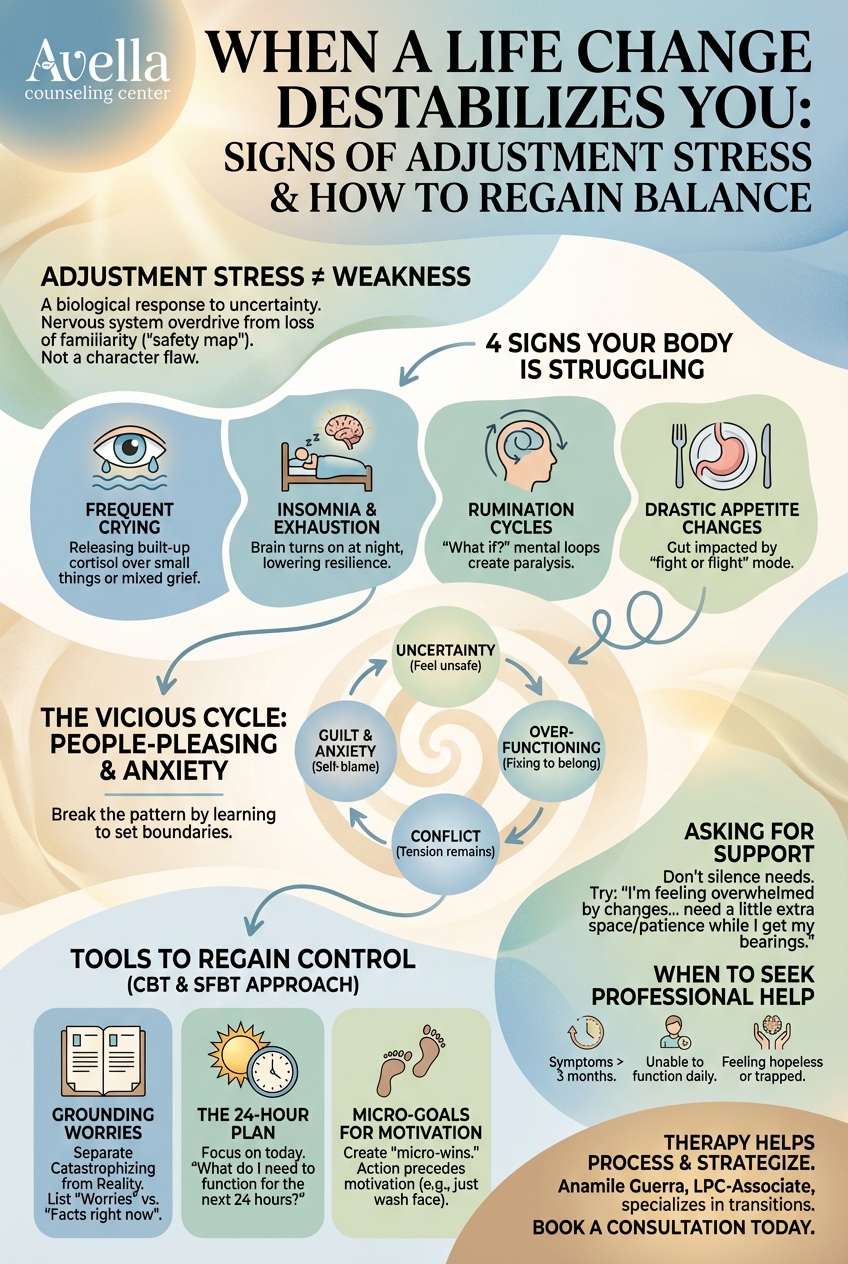
Here is the truth: Your symptoms are not a character flaw. They are a biological response to a loss of familiarity. When your brain loses its "safety map" (your old routine, your old home, your financial certainty), it signals danger. This isn't weakness; it is your body trying to find safety in a situation that feels unpredictable.
4 Signs Your Body Is Struggling to Adapt
When the stress load exceeds your current coping mechanisms, your body starts sending distress signals.
1. Frequent and Uncontrollable Crying
You might find yourself tearing up over small inconveniences, or crying every evening. Clients often report that the tears come from a mix of grief for what they left behind (a beloved town, friends, independence) and the sheer pressure of the current uncertainty. Crying is your body’s way of releasing built-up cortisol (stress hormone).
2. Insomnia and Exhaustion
You are exhausted all day, but the moment your head hits the pillow, your brain turns on. You might lay awake analyzing conversations from the day, worrying about finances, or replaying family conflicts. This lack of sleep lowers your emotional resilience, making the next day even harder.
3. Rumination: The "What Will Happen?" Cycle
This is the mental loop that won't stop.
- "What if I don't find a job soon?"
- "What if my family gets tired of me living here?"
- "Did I make a mistake moving here?"
- "Is everyone mad at me?"
This mental paralysis can make it difficult to take simple actions, like filling out an application or cooking a meal.
4. Drastic Appetite Changes
Stress impacts the gut. Some people lose their appetite entirely, forgetting to eat until they feel faint. Others may turn to emotional eating to self-soothe. Both are signs that your nervous system is in a "fight or flight" mode.
The Vicious Cycle: Uncertainty, Guilt, and Anxiety
Transitions often bring us into close quarters with family or new roommates. A common dynamic that fuels adjustment stress is people-pleasing out of fear.
When you feel unsure of your standing (for example, living in a relative's home), you might feel like you are "walking on eggshells." You may try to overcompensate by doing everything perfectly—cleaning up messes you didn't make, avoiding conflict at all costs, or taking the blame for other people's bad moods.
The cycle looks like this:
- Uncertainty: You feel unsafe or dependent on others.
- Over-functioning: You try to fix everyone else's problems to feel accepted.
- Conflict: Despite your efforts, tension still happens (because families are complex).
- Guilt: You blame yourself for the conflict ("If I had just done more, they wouldn't be mad").
This cycle leads to deep anxiety and resentment. Learning to set boundaries without guilt is essential to breaking this pattern.
Tools to Regain Control (CBT & SFBT Approach)
If you feel like you are drowning, you don't need a 5-year plan. You need a life raft. Here are three techniques we use in therapy to help stabilize the nervous system.
1. Grounding Your Worries
When rumination takes over, get it out of your head and onto paper. Make two columns:
- Column A: What I am worried about (e.g., "I will never find a job.")
- Column B: The facts right now (e.g., "I have submitted two applications. I have a place to sleep tonight.")
This helps separate catastrophizing from reality.
2. The 24-Hour Plan
Anxiety loves to live in the future. Depression often lives in the past. To stabilize, you must live in today. Instead of worrying about next month's rent, ask yourself: "What do I need to do to function just for the next 24 hours?"
This might include:
- Eating three meals.
- Sending one email.
- Getting outside for 10 minutes.
3. Micro-Goals for Motivation
When you are depressed or burned out, motivation does not appear magically. You have to create it with "micro-wins." If a shower feels like too much, your goal is just to wash your face. If looking for a job is overwhelming, your goal is just to open your laptop. Cognitive Behavioral Therapy suggests that action precedes motivation, not the other way around.
How to Ask for Support Without Feeling Like a Burden
Many people suffering from adjustment stress withdraw because they feel like a burden to their partners or family. You might fear that expressing your needs will cause rejection.
However, silence usually increases tension. Try using a simple script to communicate your needs:
"I am feeling a bit overwhelmed by all these changes lately. It’s not about you, but I’m struggling to adjust. I might need a little extra space/patience this week while I get my bearings."
You do not have to "earn" your place in your family by being perfect. You are allowed to be human.
When Should You Seek Professional Help?
It is normal to feel stress for a few weeks after a big change. However, according to the Mayo Clinic, you should consider professional help if:
- Symptoms persist for more than 3 months.
- You are unable to function at work or in your daily routine.
- You feel hopeless or trapped.
Therapy isn't just about "venting." It is a space to order your priorities, process the grief of the life you left behind, and build a strategy for your new reality.
Anamile Guerra, LPC-Associate, specializes in helping individuals navigate complex life transitions, family conflicts, and anxiety. She offers a compassionate, bilingual (English/Spanish) space where you don't have to apologize for your feelings.
Don't navigate this transition alone.
Book a consultation with Anamile Guerra today.
FAQ: Adjustment Stress
How long does adjustment disorder last?
Symptoms usually begin within three months of a stressful event and last no longer than six months after the stressor has ended. However, if the stressor continues (like ongoing unemployment or family conflict), symptoms can become chronic without support.
Is it depression or adjustment stress?
They can look similar. The main difference is that adjustment stress is a reaction to a specific life event. Once the person adapts or the situation improves, symptoms usually lift. Clinical depression may occur without a specific trigger. A therapist can help distinguish between the two.
Can children get adjustment stress?
Yes. Children struggle with transitions like moving or divorce just as adults do, though they may show it through behavioral acting out rather than sadness.
Disclaimer: This article is for informational purposes only and does not constitute medical advice or a therapeutic relationship. If you are in crisis, please call 988 or go to your nearest emergency room.