You are safe in bed. The lights are out, the doors are locked, and the house is quiet. You are ready to sleep, but suddenly, a wave of intense fear washes over you.
It’s not just a worry about tomorrow’s to-do list. It is a visceral, physical sensation—a racing heart, shallow breath, or a tight chest. Your brain immediately interprets this sensation as a warning: “Something is wrong. Something bad is happening.”
If you have experienced this, you are not alone. Many of the clients I see at Avella Counseling describe this exact scenario. They often tell me, "I felt a great fear, as if something terrible was happening, even though I knew I was safe."
This experience can be terrifying, especially when it leaves you feeling "cloudy" or foggy the next day, unable to remember exactly how the episode ended.
The good news is that this is not a prediction of doom. It is a biological false alarm. This guide will help you understand why this happens and give you a practical, 10-minute plan to navigate the wave when your mind goes blank.
Why Nighttime Fear Feels So Convincing (Even When You're Safe)
Why does anxiety wait until you are exhausted to strike? There are often two main culprits: biology and the loss of control.
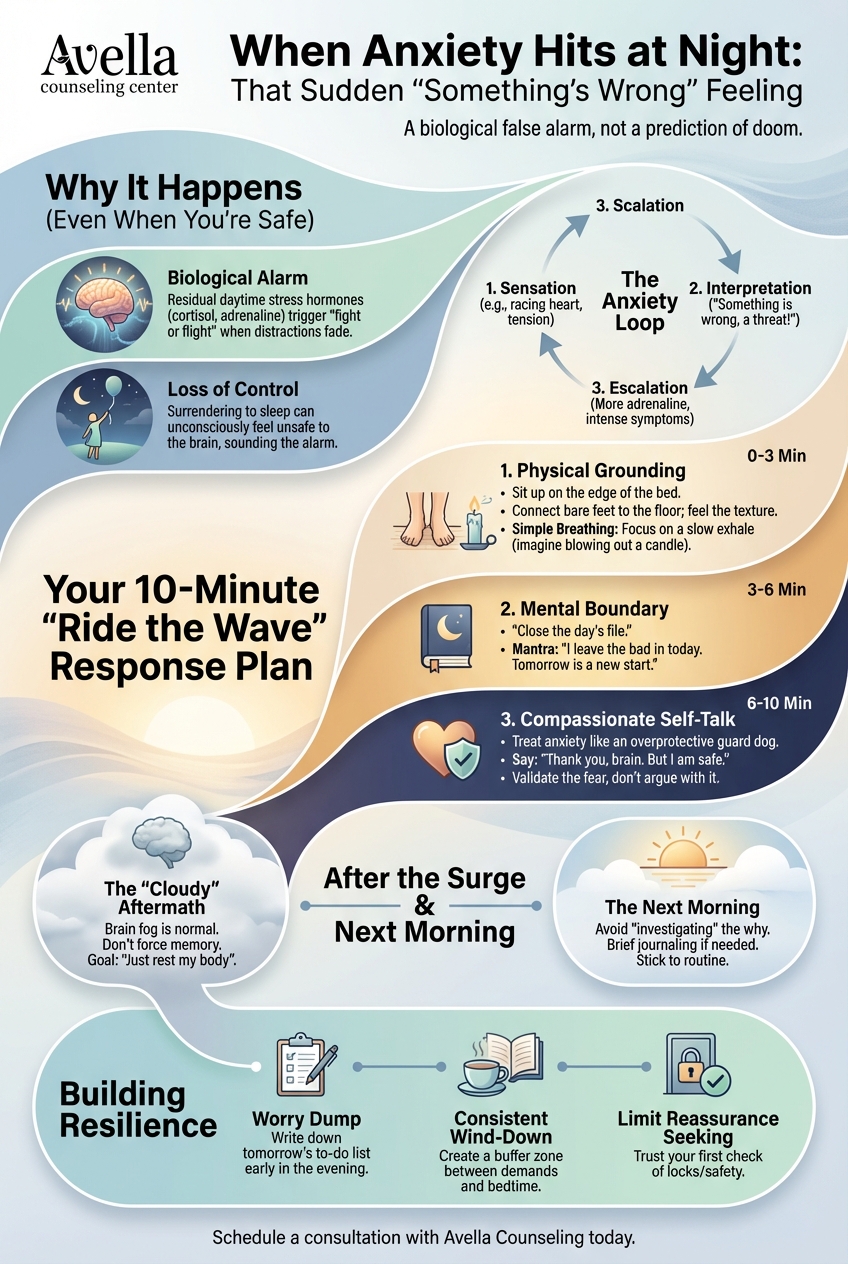
The Biological Alarm
Throughout the day, your body accumulates stress hormones like cortisol. If you’ve had a busy day—managing work, traffic, or family needs—your nervous system has been in "go mode." When you finally lie down, the distractions fade, but the adrenaline may still be circulating. Your body misinterprets this residual energy as a current threat, triggering a "fight or flight" response.
The Loss of Control
Sleep requires us to let go. For many people, especially those who find safety in routine and controlling their environment, the act of falling asleep can unconsciously feel unsafe.
We often manage anxiety during the day by staying busy and keeping a strict schedule. At night, we have to surrender that control to sleep. If your brain perceives this loss of control as vulnerability, it might sound the alarm just as you drift off.
The Anxiety Loop: From Body Alarm to "Something is Wrong"
Understanding the mechanics of a panic surge can take away some of its power. The loop usually looks like this:
- Sensation: You feel a physical symptom (heart palpitations, heat, tension).
- Interpretation: Your brain searches for a reason. Because you feel fear, your brain concludes there must be a threat. You might think, "I feel like something is happening."
- Escalation: This interpretation fuels more adrenaline, making the physical symptoms more intense.
This loop can make you feel like you are losing your mind, but you are simply experiencing a mechanical mismatch between your body’s alarm system and your safe environment.
Your 10-Minute "Ride the Wave" Response Plan
When this fear hits, your mind might feel "cloudy," blank, or unable to focus. You don't need complex psychological theories in that moment; you need a simple, physical plan.
Here is a strategy to help you ride out the surge without fighting it.
1. Physical Grounding (Minutes 0-3)
When your mind is racing, you cannot "think" your way out of fear. You must use your body.
- Sit up: If lying down feels suffocating, sit on the edge of the bed.
- Connect to the floor: Place your bare feet flat on the floor. Feel the carpet or wood.
- Simple Breathing: Don't force deep breaths if it feels tight. Just focus on a slow exhale. Imagine blowing out a candle very slowly.
2. The "Mental Boundary" Mantra (Minutes 3-6)
Anxiety often blurs the line between today’s stress and tomorrow’s worries. You need a mental boundary.
One powerful technique is to use a specific phrase to "close" the day. A phrase I often discuss with clients is: “I leave the bad in today. Tomorrow is a new start.” (Or in Spanish, "Todo lo malo lo dejo hoy.")
Repeat this gently. You are telling your brain that the "file" for today is closed, and you don't need to carry the emotional weight of the last 24 hours into your sleep.
3. Compassionate Self-Talk (Minutes 6-10)
When the fear says, "Something is wrong," do not argue with it aggressively. Instead, treat your anxiety like an overprotective guard dog barking at a falling leaf.
- Say: "Thank you, brain, for trying to protect me. But there is no tiger here. I am safe in my bed."
- Validate: It is okay to feel fear. It is uncomfortable, but it is not dangerous.
What to Do If Your Mind Goes Blank (The "Cloudy" Aftermath)
It is very common to feel "cloudy" or foggy during or after a nighttime anxiety episode. You might wake up the next morning unable to remember exactly when you fell asleep or what thoughts helped you calm down.
This "brain fog" is a normal after-effect of a stress response. Please do not force yourself to remember or analyze the episode.
- Don't force memory: It’s okay if the details are blurry.
- The "Good Enough" Goal: If you can’t sleep immediately, change your goal from "I must sleep" to "I will just rest my body." Resting your eyes and muscles is beneficial even if you are awake.
For more on handling sleep disruptions, you might find our resources on sleep issues and insomnia helpful.
The Next Morning: Debrief Without Rumination
The morning after a panic episode, the temptation is to investigate why it happened. However, obsessing over the "why" can keep the anxiety alive.
- Avoid the "Investigation": Don't spend the day replaying the fear.
- Brief Journaling: If the thoughts persist, write them down once to get them out of your head, then close the notebook.
- Stick to Routine: If you find comfort in routine, stick to your normal morning schedule. Predictability signals safety to the nervous system.
Small Practices to Build Nighttime Resilience
To reduce the likelihood of these surges returning, we want to lower your overall baseline stress.
- The Worry Dump: Early in the evening, write down your to-do list for tomorrow. This prevents your brain from trying to "hold" these tasks while you sleep.
- Consistent Wind-Down: Create a buffer zone between the day’s demands and bedtime. This prepares your brain for the loss of control that comes with sleep. Learn more about mindfulness techniques that can aid this transition.
- Limit Reassurance Seeking: Checking the locks once is safety; checking them five times is anxiety. Trust your first check.
Summary
Sudden nighttime anxiety is uncomfortable, but it is manageable. It is a biological wave, not a prediction of the future. By grounding your body and setting mental boundaries, you can teach your brain that it is safe to let go and rest.
If sudden surges of fear are keeping you awake or making you dread bedtime, you don't have to handle it alone. We can help you build a personalized response plan. Schedule a consultation with Avella Counseling today.
Frequently Asked Questions
Is it normal to have a panic attack while sleeping?
Yes. These are often called "nocturnal panic attacks." According to the Mayo Clinic, they can wake you from sleep with the same symptoms as a daytime panic attack (racing heart, sweating, shaking), often without an obvious trigger.
Why do I feel fear at night for no reason?
When we are busy during the day, we can distract ourselves from stress. At night, when distractions fade, the brain may process the accumulated stress of the day. The Anxiety and Depression Association of America (ADAA) notes that sleep disruption is a common feature of anxiety disorders, as the brain remains in a state of hyperarousal.
About the Author:
Anamile Idalia Guerra is a Licensed Professional Counselor Associate (LPC-A) at Avella Counseling, supervised by Jennifer Gonzalez, MS, LPC-S, and Amanda Varnon, MA, LPC-S. She is bilingual (English/Spanish) and uses a person-centered, collaborative approach to help clients navigate anxiety, stress, and life transitions.
Disclaimer: This blog post is for informational purposes only and does not constitute medical advice or a therapeutic relationship. If you are experiencing a medical emergency, please call 911.