Have you ever noticed that you feel perfectly fine while you are in motion? As long as you are folding laundry, chasing after children, or tackling a work project, your mind feels relatively clear. But the moment you sit down to rest—perhaps at the end of a long day—a wave of anxiety or heaviness washes over you.
This is a very common experience. In therapy, we often explore the delicate balance between using activity as a helpful tool and using it as a shield.
While staying active is often a powerful antidepressant, using it to outrun your thoughts is usually a temporary fix that can lead to burnout. The difference lies in the mechanism driving the behavior. Here is how to tell the difference between healthy Behavioral Activation vs. Avoidance, and how you can find peace in the quiet moments, too.
The Science of “Doing”: What is Behavioral Activation?
At its core, Behavioral Activation (BA) is a therapeutic concept often used in Cognitive Behavioral Therapy (CBT). It is based on a simple truth: our actions influence our mood.
When you feel depressed or anxious, the natural instinct is often to withdraw or “freeze.” However, this inactivity often fuels the cycle of negative thinking. Behavioral Activation flips this script by encouraging you to engage in specific behaviors before you feel motivated to do them.
When you engage in purposeful activities—whether that is caring for a grandchild, cleaning the house, or finishing a task—your brain often releases neurochemicals that improve your mood, specifically dopamine and serotonin. This process shifts your focus from internal rumination (worrying about the future or regretting the past) to external engagement.
Many people find that physically caring for others or tending to their home provides a sense of “relaxation” through focus. Even if the work is physical, the mind gets a break from spiraling thoughts. According to research on behavioral activation, this approach is highly effective because it reconnects you with positive reinforcement in your environment, breaking the isolation that often accompanies mental health struggles.
Healthy Distraction vs. Emotional Avoidance
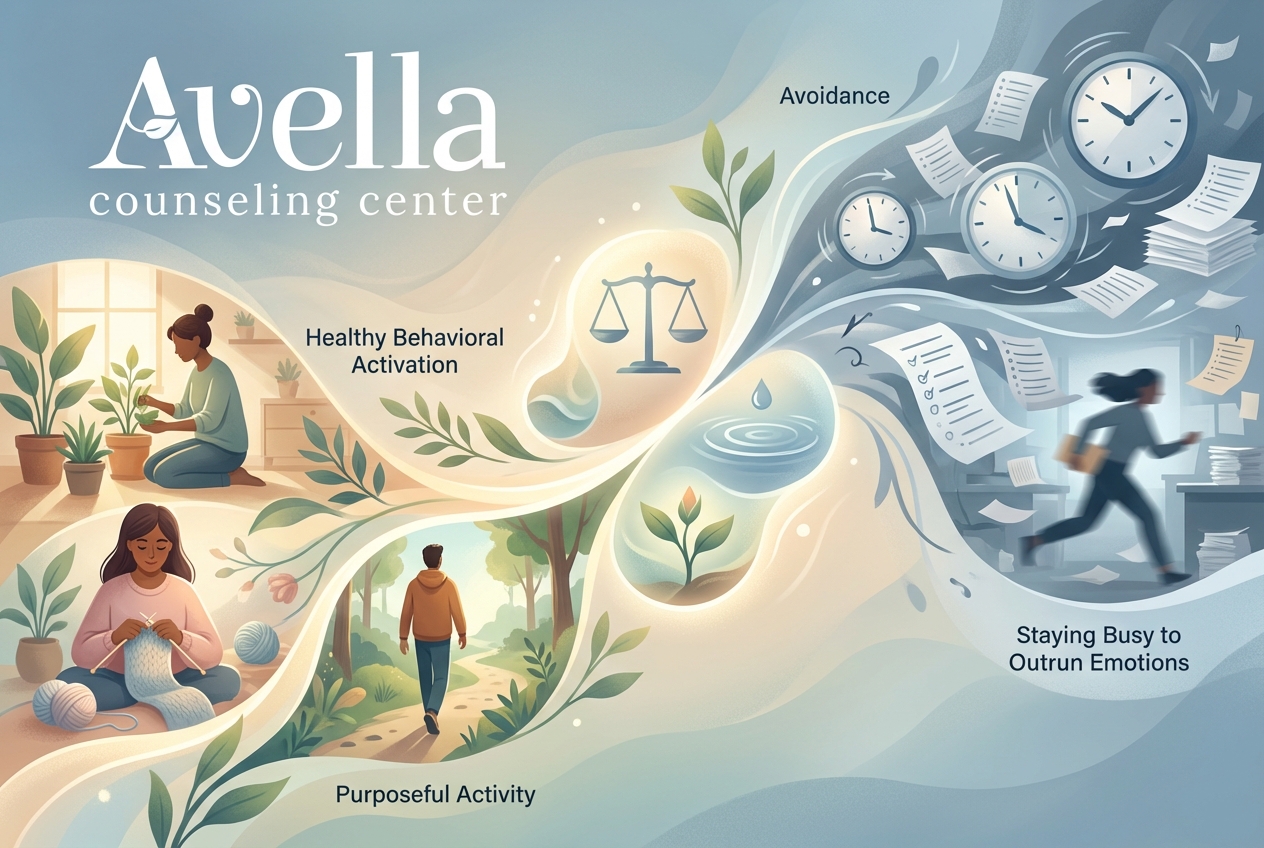
So, when does staying busy become a problem? It comes down to your intention.
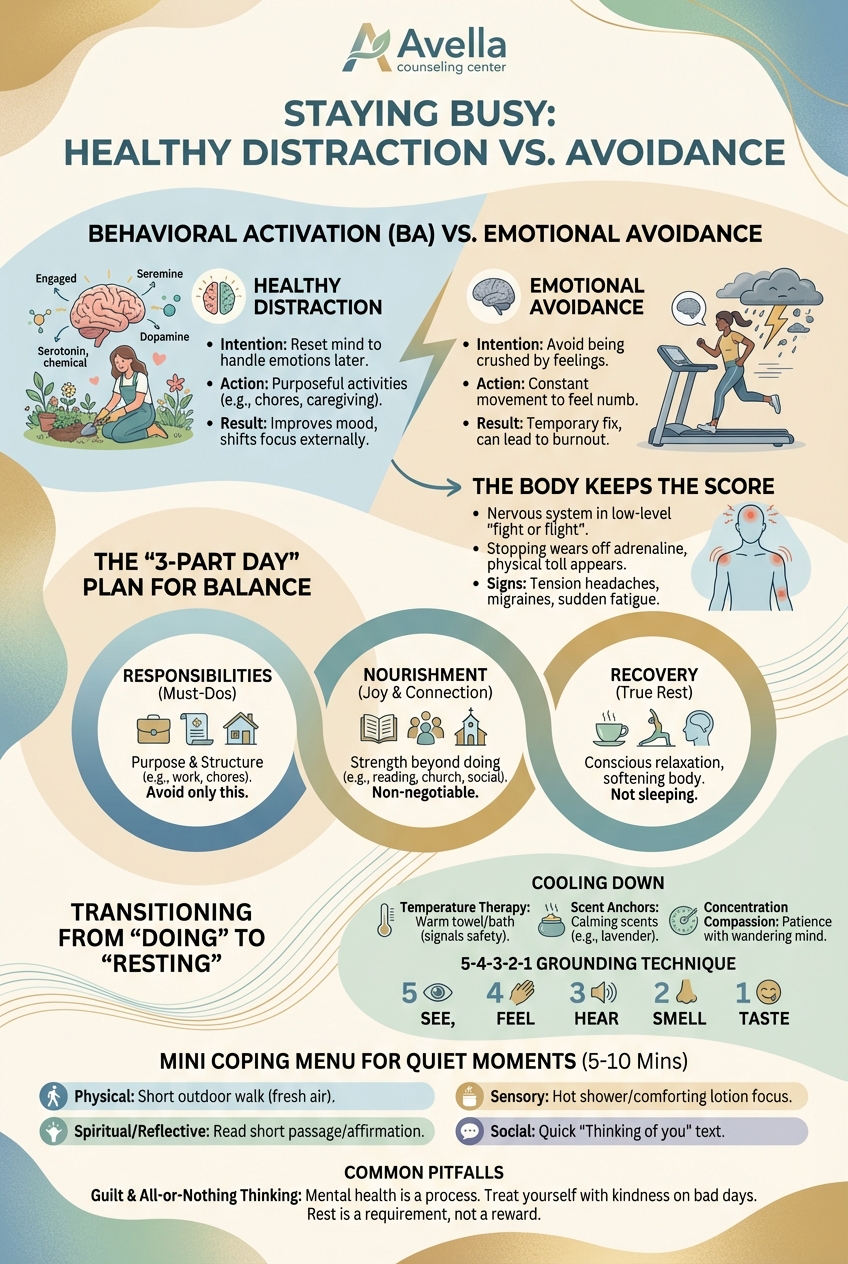
- Healthy Distraction: “I am feeling overwhelmed. I’m going to take a walk or clean the kitchen to reset my mind so I can handle this emotion better later.”
- Emotional Avoidance: “I cannot stop moving because if I sit down, I will be crushed by what I am feeling.”
The Body Keeps the Score
When we use busyness to avoid emotions, our bodies often tell on us. You might notice that when you finally stop moving, your body expresses the suppressed stress. This phenomenon occurs because your nervous system has been operating in a low-level “fight or flight” mode all day.
When you finally pause, the adrenaline wears off, and the physical toll becomes apparent. This can show up as tension headaches, migraines, or sudden, intense fatigue. It is your body’s way of processing what your mind has been ignoring. In fact, somatic symptoms of stress are frequently the first indicator that a patient is over-functioning to mask anxiety.
Quick Self-Check
Ask yourself these questions to determine where you stand:
- Am I doing this to feel accomplished, or am I doing this to feel numb?
- If I sit in a chair for 10 minutes with no phone and no TV, what happens to my body? Do I feel peace, or do I feel dread?
- Do I feel a sense of “crash” immediately after I stop working, rather than a sense of rest?
The ‘3-Part Day’ Plan for Balanced Mental Health
To move from avoidance to healthy activation, it helps to structure your day so you aren’t stuck in an “all-or-nothing” cycle. A balanced day generally includes three types of activities:
- Responsibilities: These are your “must-dos.” This includes work, caregiving, and household chores. These provide a sense of purpose and structure, which is vital for managing depression treatment. However, if your entire day is only responsibilities, you risk compassion fatigue.
- Nourishment: This is one activity done solely for joy, connection, or spiritual grounding. It could be attending a church service, connecting with a supportive community, or reading a book. These activities provide strength beyond just “getting things done.” It is important to treat these as non-negotiable appointments with yourself.
- Recovery: This is true rest. It is not sleeping, but conscious relaxation where you allow your body to soften. This might look like sitting on the porch with tea, stretching, or practicing deep breathing.
How to Transition from ‘Doing’ to ‘Resting’ Without the Spiral
The hardest part for many people is the transition. Going from 60 mph to 0 mph can feel jarring, often triggering intrusive thoughts or somatic symptoms like pain.
Instead of slamming on the brakes, try “cooling down” your brain using sensory tools. This technique is often referred to as grounding, and it helps signal to your parasympathetic nervous system that you are safe.
- Temperature Therapy: If you feel tension rising when you rest (especially in the head or neck), try using a warm towel or taking a warm bath. The physical sensation of heat can signal safety to your nervous system, dilating blood vessels and reducing the physical “clench” of anxiety.
- Scent Anchors: Using calming scents, like lavender essential oil, can help signal to your brain that it is time to switch gears from “work mode” to “rest mode.” Over time, your brain will begin to associate that specific scent with relaxation, creating a conditioned response that helps you settle down faster.
- Concentration Compassion: If you try to read or pray during your rest time, you might find your mind wandering. That is okay. If you have to read the same page twice, you haven’t failed. Be patient with your focus; the goal is the practice, not perfection.
The 5-4-3-2-1 Technique
If the transition to rest feels impossible, try this specific grounding technique before you attempt to relax:
- Identify 5 things you can see.
- Identify 4 things you can physically feel (the fabric of your chair, your feet on the floor).
- Identify 3 things you can hear (traffic outside, the hum of the AC).
- Identify 2 things you can smell.
- Identify 1 thing you can taste.
This exercise forces your prefrontal cortex to come online and focus on the immediate present, which can interrupt the “what if” loops of anxiety.
Mini Coping Menu for the Quiet Moments
If the silence feels too loud, you don’t have to jump back into work. Try one of these low-stakes activities for 5–10 minutes to bridge the gap:
- Physical: Take a short walk outside. Even if it is cold or hot, the fresh air changes your sensory input and can help break a mental loop.
- Spiritual/Reflective: Read a short passage of scripture, poetry, or a daily affirmative reader.
- Sensory: Take a hot shower or apply a comforting lotion to your hands. Focus entirely on the sensation of the water or the texture of the lotion.
- Social: Send a quick text to a supportive family member. You don’t need to ask them to fix anything—just a quick “Thinking of you” can help you feel less isolated.
Common Pitfalls: Guilt and All-or-Nothing Thinking
A major barrier to resting is the feeling that if you aren’t productive, you are failing. Or, if you have a “bad day” where physical pain or anxiety wins, you feel like you have lost all your progress.
Mental health is not a switch; it is a process. There will be days when the anxiety symptoms feel louder or when a migraine forces you to stop. The victory isn’t in never having a bad day; the victory is in treating yourself with kindness on the bad days and gently returning to your routine the next day without self-judgment.
Remember, rest is not a reward for productivity; it is a requirement for it. You cannot pour from an empty cup, and you cannot maintain a high-functioning life if you never stop to refuel.
Summary
Activity is a wonderful tool for mental health, but it shouldn’t be the only tool in your box. The goal is to build a life where you feel safe both in motion and in stillness.
If you find that the silence is unbearable or that you are keeping busy solely to survive your thoughts, you don’t have to carry that weight alone. Professional support can help you build a safer relationship with rest and give you strategies to manage the physical and emotional symptoms of stress.
Ready to find balance?
If you are looking for support in managing anxiety, depression, or stress, I am here to help. Contact Anamile Guerra, LPC-Associate, at Avella Counseling to start building your personalized coping plan today.
Anamile Idalia Guerra is a Bilingual Licensed Professional Counselor Associate supervised by Jennifer Gonzalez, MS, LPC-S, and Amanda Varnon, MA, LPC-S.