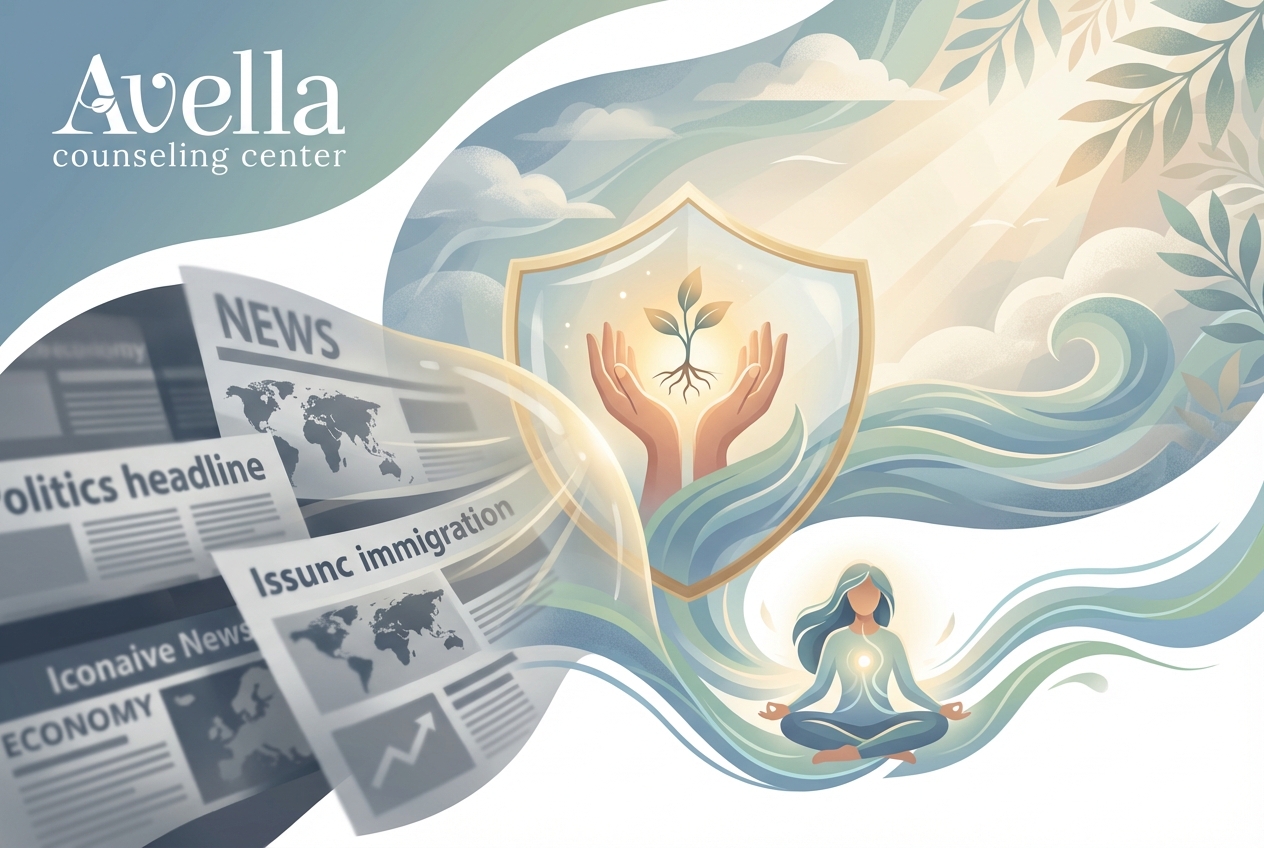
Does it feel like the world is getting louder every day? Between alerts about politics, updates on immigration laws, concerns about the economy, and safety warnings, checking your phone can feel like walking into a storm.
In our Pearland therapy practice, we often hear from people who feel a sudden shift in their mood after watching the news. You might be going about your day, feeling okay, and then one headline triggers a spiral of worry. It is not just "being sensitive." It is your body responding to a perceived threat.
If you are feeling stressed, discouraged, or fearful about the state of the world, you are not alone. Here is how to protect your peace and regain a sense of control, even when things feel uncertain.
Is the News Making You Sick? (Recognizing the Signs)
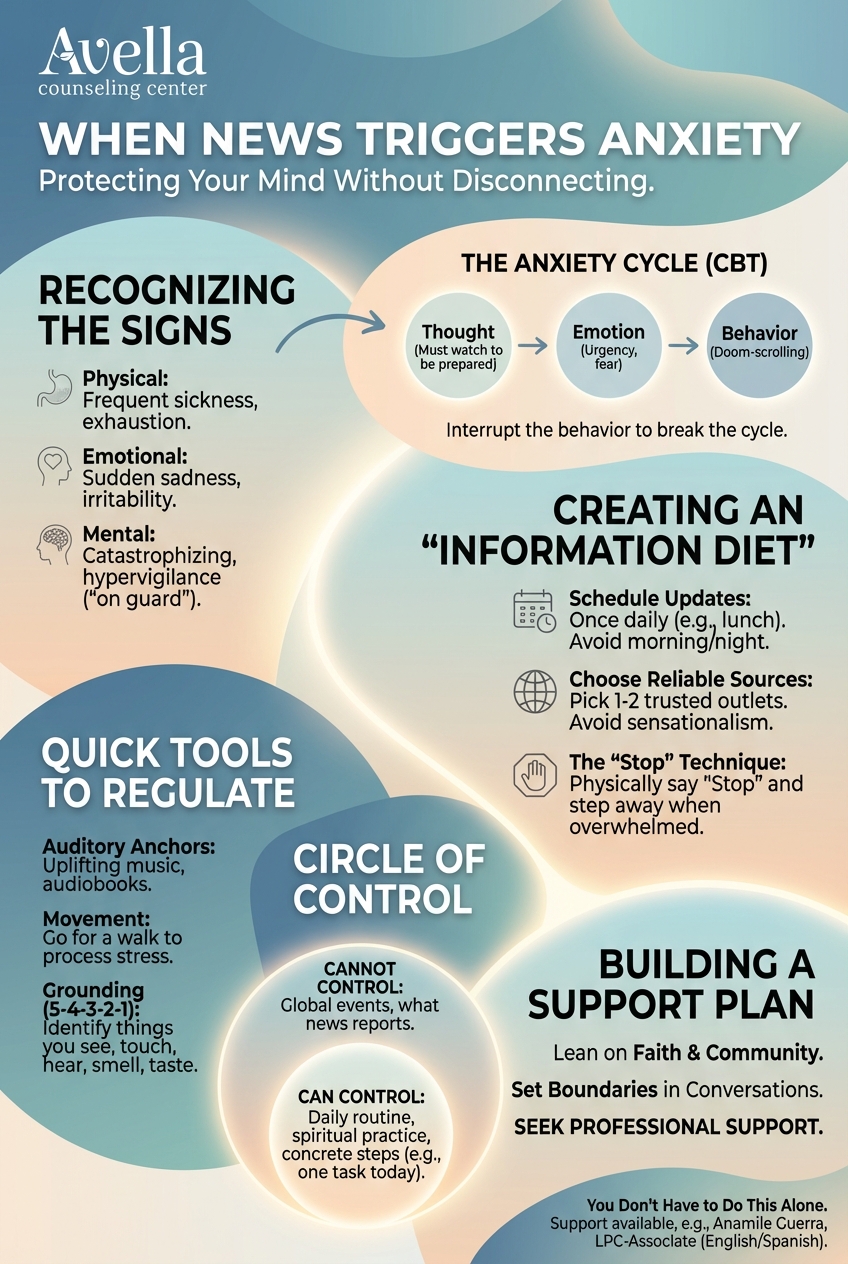
Anxiety isn’t just a thought in your head; it is a physical experience in your body. When we consume intense news repeatedly, our bodies enter a state of chronic stress. You might notice that you are getting sick more often, fighting off viruses that linger, or feeling exhausted even after sleeping.
Beyond physical illness, look for these signs of news anxiety (sometimes called "headline stress"):
- Emotional Heaviness: You feel a sudden wave of sadness or irritability after checking social media.
- Catastrophizing: You read one headline and immediately jump to the worst-case scenario regarding your family’s safety or stability.
- Hypervigilance: This is a state of being constantly "on guard."
- What this looks like: You might find yourself afraid of the dark, feeling the need to keep all the lights on to feel safe, or thinking you see shadows. When the brain is in "survival mode" from consuming scary news, it scans for danger everywhere—even in your own quiet home.
The Cycle of Anxiety and Information
From a Cognitive Behavioral Therapy (CBT) perspective, anxiety often feeds on a loop of thoughts, emotions, and behaviors.
- The Thought: "If I don't watch the news constantly, I won't be prepared for what's coming."
- The Emotion: Urgency, fear, and a need for control.
- The Behavior: Doom-scrolling for hours or leaving the TV news on in the background all day.
The result? Your nervous system stays flooded with stress hormones like cortisol. This prevents you from relaxing, even when you are sitting safely on your couch. To break this cycle, we have to interrupt the behavior.
Creating an "Information Diet"
You do not have to disconnect from the world completely to feel better, but you do need boundaries. Think of news consumption like food—too much of the wrong kind can make you sick.
- Schedule Your Updates: Try checking the news only once a day, perhaps at lunch. Avoid checking first thing in the morning or right before bed, as this disrupts your sleep cycle.
- Choose Reliable Sources: Pick 1-2 trusted outlets. Avoid getting your primary news from social media comments or sensationalized videos, which are often designed to trigger emotional reactions.
- The "Stop" Technique: When you feel your chest tighten or your stomach turn while scrolling, physically say "Stop" to yourself. Put the phone down and step away.
Quick Tools to Regulate Your Nervous System
When the headlines leave you feeling shaky or overwhelmed, you can use these tools to bring your body back to the present moment.
1. Auditory Anchors
If the news is "noise" that stresses you out, replace it with "noise" that heals. Many people find peace by switching off the radio and turning on uplifting music, worship songs (alabanzas), or audiobooks. Listening to something that speaks of hope or faith can drown out the fear narrative in your mind.
2. Movement
Stress creates energy in the body (adrenaline) that needs to go somewhere. If you are feeling anxious, go for a walk. Walking physically processes that stress energy. As you walk, try to focus on the rhythm of your steps rather than your thoughts.
3. Grounding with 5-4-3-2-1
If you feel panic rising, stop and identify:
- 5 things you can see.
- 4 things you can touch.
- 3 things you can hear.
- 2 things you can smell.
- 1 thing you can taste.
Read more about how to manage distraction and stay grounded here.
What You Can Control vs. What You Cannot
When facing large-scale issues like immigration policy or the national economy, it is easy to feel powerless. In therapy, we often use a concept called the Circle of Control.
- You Cannot Control: Presidential decisions, global markets, or what the news reports.
- You Can Control: Your daily routine, your spiritual practice, and the concrete steps you take today.
Actionable Step: When you feel paralyzed by the "big picture," zoom in on a small, concrete task.
Instead of worrying about the economy next year, focus on filling out one job application today or cooking a healthy meal for your family. Taking action—no matter how small—reminds your brain that you still have agency over your life.
Building a Support Plan
You were not meant to carry the weight of the world alone.
- Lean on Faith and Community: For many, attending church or a community group provides a safe haven. It reminds you that there is a bigger picture beyond the current news cycle.
- Set Boundaries in Conversations: It is okay to say no to conversations that distress you. If a friend constantly wants to discuss rumors or "doom and gloom" predictions, you can gently change the subject.
- Seek Professional Support: If your anxiety is preventing you from sleeping, working, or functioning, it may be time to speak with a professional.
For more resources on managing stress, the American Psychological Association offers guidance on coping with political climate stress. Additionally, NAMI provides excellent resources for managing information overload.
You Don't Have to Do This Alone
If the political climate, immigration news, or general world events are keeping you up at night, support is available.
Anamile Guerra, LPC-Associate, offers a safe, culturally sensitive space to process these fears. Fluent in both English and Spanish, Anamile understands the unique stressors that affect our diverse community in Pearland.
Ready to reclaim your peace?
Visit Anamile Guerra’s profile to learn more or schedule a consultation today. We are here to help you navigate these uncertain times with strength and resilience.