

You get the text message or the email: your hours for next week have been cut. Or perhaps your shift has been moved from morning to night with zero notice. Suddenly, the plan you had for paying bills, spending time with family, or simply sleeping has to be thrown out the window.
If you work in the gig economy, shift work, or an industry with fluctuating schedules, you know the specific type of exhaustion that comes from having the rug pulled out from under you. It is not just about the money (though that is a huge part of it); it is the mental fatigue of having to constantly "reset" your life.
As a therapist, I often see clients who feel like they are living in a state of constant emergency. This uncertainty can trigger anxiety that feels heavy and overwhelming. However, using tools from Cognitive Behavioral Therapy (CBT) and a solution-focused approach, you can regain a sense of stability, even when your schedule is anything but stable.
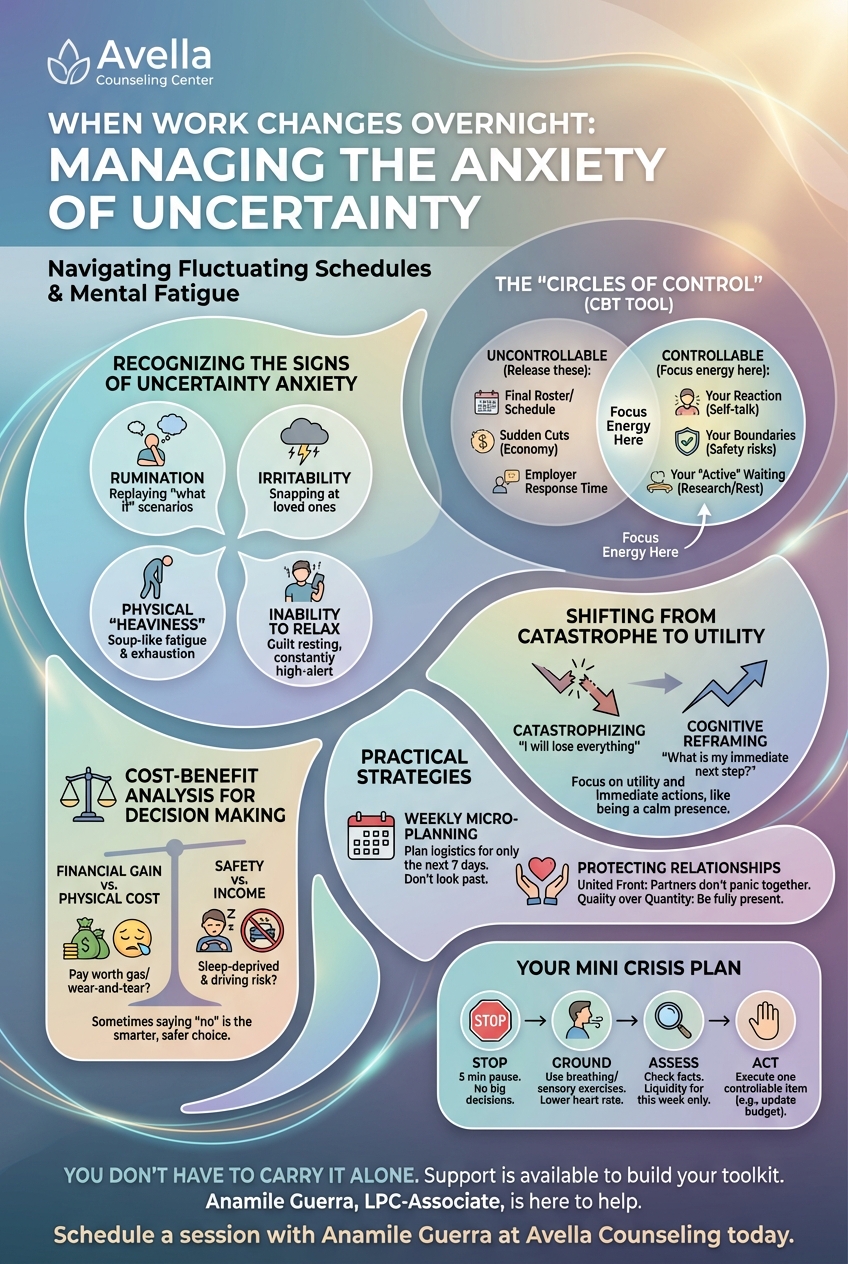
Recognizing the Signs of Uncertainty Anxiety
Anxiety doesn’t always look like a panic attack. When you are dealing with job instability, anxiety often disguises itself as "being responsible" or "staying alert." However, living in high-alert mode eventually takes a toll on your body and mind.
Watch for these signs:
- Rumination: You replay "what if" scenarios about bills or shifts over and over, even when you can’t do anything about them right now.
- Irritability: You find yourself snapping at your partner or children because your mind is elsewhere.
- Physical "Heaviness": Beyond normal tiredness, you might feel a "soup-like" fatigue—a mix of physical exhaustion from irregular sleep and the mental weight of stress.
- Inability to Relax: You feel guilty resting because you feel you should be checking your phone or looking for more work.
If this sounds familiar, know that this is a normal reaction to an abnormal amount of stress. But we want to prevent this stress from turning into burnout.
The "Circles of Control" (A CBT Tool)
One of the most effective ways to manage anxiety from job instability is to visualize your Circles of Control. When we worry, we often blend things we can do with things we cannot do, creating a giant ball of stress.
Try separating them:
The Uncontrollable (Release these):
- The final roster your manager posts.
- Sudden cuts in hours due to the economy or "slow season."
- How quickly an employer calls you back.
The Controllable (Focus energy here):
- Your Reaction: How you talk to yourself when bad news hits.
- Your Boundaries: Deciding what safety risks you are willing to take.
- Your "Active" Waiting: Instead of sitting by the phone (passive waiting), using that time to research other options or rest (active choice).
When you catch yourself worrying about the roster, gently remind yourself: "That belongs to the employer. My job right now is to manage my budget and my energy."
Shifting from Catastrophe to Utility
When hours get cut, our brains often jump to the worst-case scenario: "I will lose everything." This is called catastrophizing.
In therapy, we don't try to cover this up with toxic positivity. We don't say, "Everything happens for a reason," because that invalidates your stress. Instead, we use Cognitive Reframing to shift from catastrophe to utility.
Ask yourself: "What is my immediate next step?"
For example, I have worked with clients who realized that while they couldn't control their work hours, they could control the emotional tone in their home. They decided that panic wouldn't help the situation, so they focused on being a calm presence for their children. This didn't fix the schedule, but it gave them a sense of purpose and control, which significantly lowered their anxiety.
The Cost-Benefit Analysis for Decision Making
When income fluctuates, the impulse is to say "yes" to every single opportunity. If a shift opens up 45 minutes away at midnight, you might take it out of fear.
However, anxiety often makes us ignore the hidden costs. I encourage you to use a cost-benefit analysis before saying yes:
- Financial Gain vs. Physical Cost: Is the pay for a 3-hour shift worth the gas money and the wear-and-tear on your car?
- Safety vs. Income: Are you so sleep-deprived that driving to this job puts you at risk of an accident?
There is a difference between working hard and putting yourself in danger. Sometimes, saying "no" to a shift that disrupts your sleep cycle or costs too much in gas is actually the smarter, more financially responsible choice in the long run.
The 15-Minute "Micro-Planning" Session
Trying to plan your whole month when your schedule changes weekly is a recipe for frustration. It sets you up to feel like you are failing every time plans change.
Instead, try Weekly Micro-planning.
Once the new schedule drops, set aside just 15 minutes. Adjust your logistics—rides for kids, meal prep, sleep hours—only for the next 7 days. Do not look past that horizon. This manages stress by breaking a massive problem down into a bite-sized, manageable week.
Protecting Family and Relationships from the Stress
Financial uncertainty often ripples into our relationships. It is easy for partners to feed off each other’s anxiety.
To protect your relationships:
- The United Front: Agree with your partner that you won’t panic at the same time. If one person is spiraling, the other holds the ground.
- Quality over Quantity: You may have to work long hours, but you can explain to your children that working hard is how you show love. When you are home, try to be fully present—even if it's just eating dinner together at a late hour. That consistency matters more to children than you might think.
Your Mini Crisis Plan
What do you do when the "crisis hits"—for example, when you look at the schedule and the hours aren't there?
- Stop: Do not make calls, send angry texts, or make big decisions for 5 minutes.
- Ground: Use breathing exercises or sensory techniques to lower your heart rate. You cannot think clearly when your body is in fight-or-flight mode.
- Assess: Look at the facts. Check your "Liquidity vs. Solvency." Do you have enough for this week? Focus on the immediate facts, not the fears.
- Act: Execute one item from your controllable list, such as updating a resume or adjusting the weekly grocery budget.
You Don't Have to Carry It Alone
Living with uncertainty is exhausting. It takes immense patience and resilience to navigate a career path that changes day to day. While you cannot control the economy or your employer, you can build a toolkit that protects your mental health from the rollercoaster ride.
If the weight of uncertainty is making it hard to sleep, function, or connect with your family, support is available. You don't have to figure this out alone.
Anamile Guerra, LPC-Associate, is here to help you build a personalized plan to manage anxiety and regain your footing.
Schedule a session with Anamile Guerra at Avella Counseling today.
External Resources for further reading: