

It happens in a split second. One moment, you are asking your child to do something simple—like put on their shoes or turn off a light—and the next, the volume in the room has skyrocketed. You yell. Silence follows, and then perhaps tears.
Almost immediately, the wave of guilt crashes over you. You might think, “I’ve ruined them,” or “I’m a terrible parent.”
I want to start by offering you some grace: You are not a bad parent. You are a human being with a nervous system that has limits.
In my practice as a therapist, I work with many parents who are doing their best to manage work, household logistics, and their children’s needs. We often find that yelling isn't a sign of lack of love; it is a sign of a nervous system that has run out of resources.
Here is how we can understand what happens in your body, how to minimize those explosions, and most importantly, how to repair the relationship when they happen.
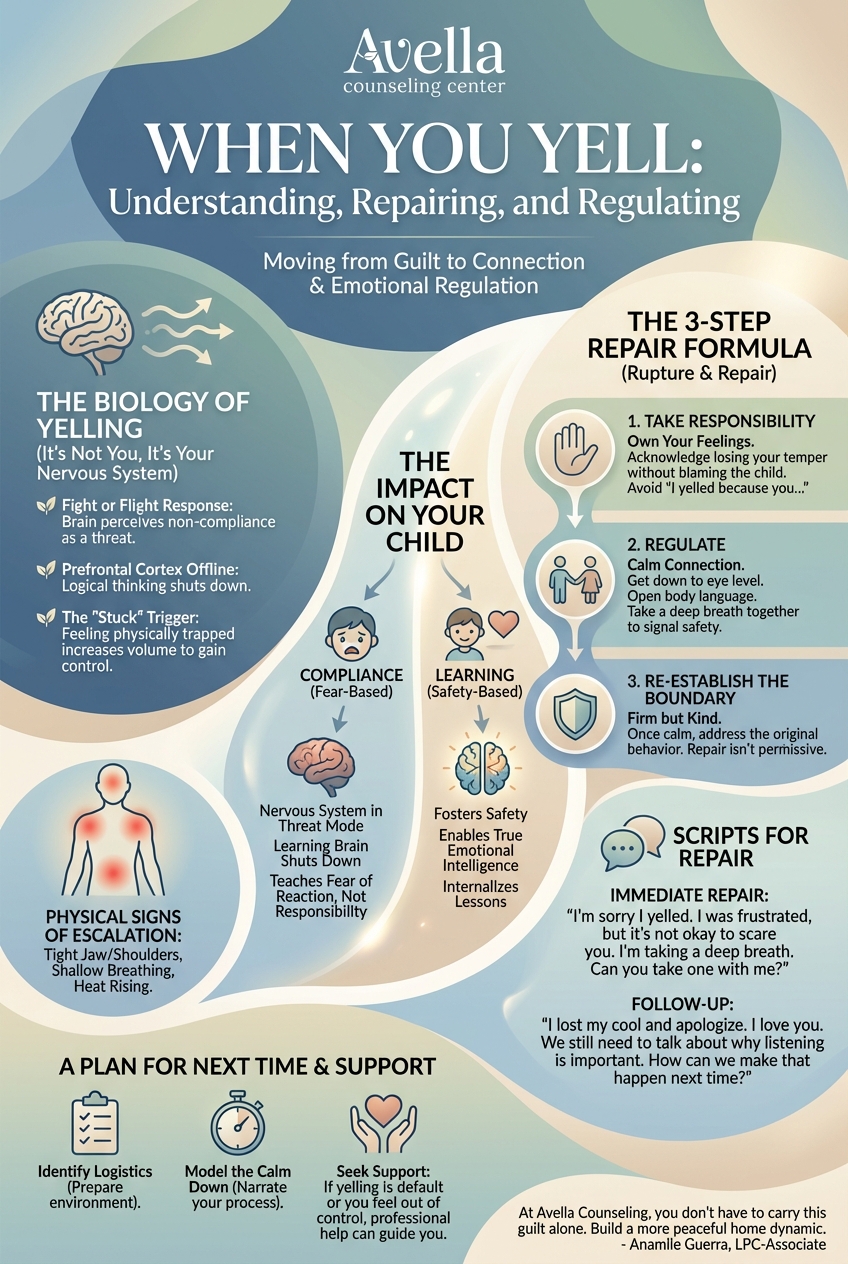
Why Yelling Happens (Without Demonizing Yourself)
To change a behavior, we first have to understand the biology behind it. When you yell, it is often because your brain has shifted into a "Fight or Flight" response.
When you are stressed, tired, or overwhelmed, your brain perceives your child’s non-compliance not just as annoying, but as a threat. Your body floods with stress hormones, and your logical brain (the prefrontal cortex) goes offline.
The "Stuck" Trigger
A common scenario I discuss with parents involves being physically restricted. Imagine you are holding a sleeping baby who finally just settled down, or you are in the middle of a crucial work call. You need your older child to do something—perhaps go to the bathroom or pick up a toy—and you cannot get up to help them.
When you feel physically stuck and your child ignores your calm request, your body feels trapped. To compensate for your inability to move, your brain instinctively increases your volume to gain control. It is a biological attempt to be "heard" when you feel powerless.
Recognizing Your 'Point of No Return'
The key to reducing yelling is catching yourself before you explode. This requires noticing what is happening in your body.
Common physical signs of escalation include:
- A tightening in your jaw or shoulders.
- Shallow, rapid breathing.
- A feeling of heat rising in your chest or face.
You might also notice a shift in your perception. You stop seeing your child as a little human struggling with a transition and start seeing them as "malicious" or doing it "on purpose to make me mad."
When you feel these signs, you are at your limit. This is the moment to pause—even if it means stepping into another room for 30 seconds to breathe.
The Impact: What the Child Hears
It is important to understand the difference between compliance and learning.
When a parent yells, the child’s nervous system also goes into threat mode. I have worked with families where a child dissolves into tears not because they didn't want to do the task, but because the volume and tone scared them.
When a child is frightened, their "learning brain" shuts down. They might do what you ask to stop the yelling (compliance), but they aren't internalizing the lesson or learning responsibility. They are simply learning to be afraid of the reaction.
To foster true emotional intelligence and cooperation, the child needs to feel safe.
The 3-Step Formula for Repair
In parenting psychology, we talk about "Rupture and Repair." A rupture is the conflict (the yell). The repair is what happens next. A strong relationship isn't built on perfection; it is built on how we fix the disconnects.
If you have yelled, use this 3-step formula to reconnect:
1. Take Responsibility (Own Your Feelings)
Acknowledge that you lost your temper without blaming the child. Avoid saying, "I yelled because you wouldn't listen." This places the responsibility for your emotional regulation on a child. Instead, own your reaction.
2. Regulate (Calm Connection)
Come down to their eye level. Ensure your body language is open and safe. Take a deep breath together. This signals to their nervous system that the "threat" is gone.
3. Re-establish the Boundary
Repairing doesn't mean you are being permissive. Once calm is restored, you address the original behavior firmly but kindly.
"What Do I Say?" (Scripts for Parents)
Knowing what to say in the heat of the moment can be hard. Here are scripts you can adapt:
The Immediate Repair:
"I’m sorry I yelled. I was feeling very frustrated, but it is not okay for me to scare you with my big voice. I am going to take a deep breath. Can you take one with me?"
The Follow-Up (Setting the Boundary):
"I lost my cool earlier, and I apologize. I love you. Now, we still need to talk about why it's important to listen when I ask you to turn off the lights. How can we make that happen next time?"
This approach models emotional regulation for your child. You show them that it is possible to make a mistake, apologize, and try again.
A Plan for Next Time
If you find yourself yelling frequently, it can help to have a prevention plan.
- Identify Logistics: If you know you get triggered when you are "stuck" (like nursing a baby), try to prepare the environment beforehand so the older child needs less direction during that time.
- Model the Calm Down: Narrate your process out loud. "Mommy is feeling frustration bubbling up in her chest. I’m going to close my eyes and count to ten before I speak again."
- External Resources: Sometimes, understanding the brain science helps. The Whole-Brain Child by Dr. Dan Siegel offers excellent visuals on how the brain "flips its lid" during stress.
When to Seek Extra Support
Parenting is arguably the hardest job in the world. However, if you feel that:
- Yelling has become your default mode of communication.
- You feel "out of control" or unable to stop even when you want to.
- Your child is showing signs of chronic anxiety or fear.
It may be helpful to speak with a professional. Therapy can provide a space to process your own triggers, manage parenting stress, and learn specific strategies to regulate your nervous system.
At Avella Counseling, we believe that you don't have to carry this guilt alone. We can help you navigate the challenges of parenthood and build a more peaceful home dynamic.
If you are ready to find more balance and connection in your parenting journey, please reach out to me, Anamile Guerra, LPC-Associate, to schedule a consultation.