

By Anamile Guerra, LPC-Associate
Supervised by Jennifer Gonzalez, MS, LPC-S and Amanda Varnon, MA, LPC-S
It is a confused, exhausting scenario that many parents face during parent-teacher conferences. The teacher looks at you and says, "Your child is a joy to have in class! They follow directions perfectly, help their friends, and are always on task."
You want to be relieved. But inside, you are thinking: Are we talking about the same child?
Because 20 minutes after pickup, that "perfect" student is screaming, melting down over a broken cracker, or refusing to put on their shoes. In my work with families, I have heard children describe this dynamic themselves. A child might tell me they are an "angel" at school where they "do everything correctly," yet they admit to feeling "nervous" or unsettled around their parents.
This isn’t because you are doing something wrong, and it isn’t because your child is being manipulative. It is a phenomenon often called After-School Restraint Collapse.
Why "After-School Restraint Collapse" Happens
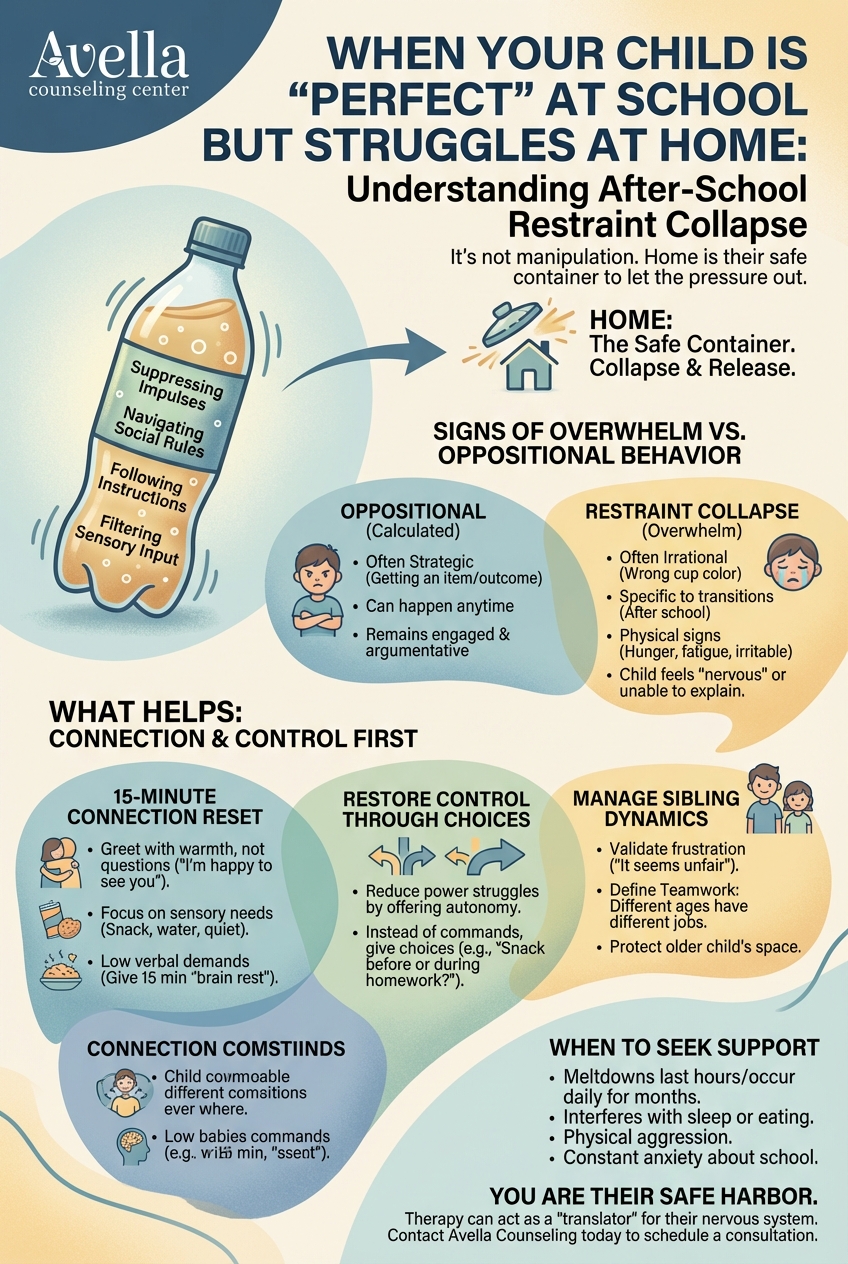
To understand why your child falls apart at home, imagine a bottle of soda.
From the moment your child enters school (often as early as 7:00 AM) until dismissal at 2:00 PM or later, they are "shaking the bottle." They are:
- Suppressing impulses (sitting still when they want to run).
- Navigating complex social rules.
- Following strict instructions to "do everything correctly."
- Filtering out loud noises and bright lights.
Every time they hold it together, the pressure builds. When they finally see you, the "lid" comes off.
Home is their safe container. You are their safe person. They know that no matter how big their feelings get, you will not fire them or expel them. They collapse with you because they feel safe enough to stop holding it all in.
Signs Your Child Is Overwhelmed vs. Oppositional
When a child is screaming or refusing to listen, it can feel like defiance. However, there is a difference between a child who is testing boundaries and a child whose nervous system is overwhelmed.
Oppositional Behavior:
- Often calculated or strategic (trying to get a specific item or outcome).
- Can happen at any time of day.
- The child often remains engaged and argumentative.
Restraint Collapse (Overwhelm):
- Often irrational (crying over the "wrong" color cup).
- Happens specifically during transitions (after school, before dinner).
- Physical signs: glazed eyes, hunger, irritability, or shutting down.
- The child may describe feeling "nervous" or simply unable to explain why they are upset.
Understanding this difference is crucial. If we treat a meltdown like defiance, we often escalate the situation. If we treat it like anxiety or overwhelm, we can help them regulate.
Connection-First Transitions: The 15-Minute Reset
When you pick your child up, your instinct might be to ask, "How was your day? What did you learn? Did you eat your lunch?"
For a child who is mentally exhausted, these questions feel like an interrogation. I have worked with children who struggle to recall specific details—like what they ate or what art project they did—because their brains are simply tired. Pressing for details can increase their stress.
Try the "Connection First" approach:
- Greet with warmth, not questions. A simple "I’m so happy to see you" is enough.
- Focus on sensory needs. Their blood sugar might be low, or they might be overstimulated. Offer a crunchy snack, a heavy blanket, or a drink of water before asking any questions.
- Low verbal demands. Give them 15 minutes of "brain rest." Let them listen to music or look out the window without needing to talk.
Reducing Power Struggles: How to Give Choices
At school, your child likely follows a strict schedule where they have very little control. When they get home, they are desperate to regain a sense of autonomy. This is why simple commands like "Put your bag away" are met with explosion.
To help reduce friction, try restoring control through choices:
- Instead of: "Start your homework right now."
- Try: "Do you want to have a snack before homework, or do you want to eat while you work?"
- Instead of: "Put your shoes away."
- Try: "Do you want to put your shoes in the bin or line them up by the door?"
This strategy supports positive parenting by validating their need for control while still maintaining necessary boundaries.
The Sibling Dynamic: "Why do I have to, but he doesn't?"
Restraint collapse often triggers sibling rivalry. A Kindergartener who has spent seven hours following rules may come home to see a 2- or 3-year-old sibling playing freely.
If the older child is immediately asked to "be the big kid" or pick up toys the younger sibling played with, resentment flares. They feel the injustice of having to work hard all day while the younger sibling "gets away with everything."
To help manage this:
- Define Teamwork: Explain that different ages have different jobs, but everyone helps.
- Protect Their Space: Ensure the older child has a zone where their things are safe from the younger sibling.
- Validate the Frustration: It is okay for them to feel annoyed. acknowledging it ("It seems frustrating that he made a mess") often works better than correcting it immediately.
For deeper conflicts, family counseling can provide a space to navigate these changing dynamics.
When to Seek Professional Support
While after-school meltdowns are common, they usually subside as the child adjusts to the school routine. However, you may want to consider professional support if:
- The meltdowns last for hours or occur every single day for months.
- The collapse interferes with sleep or eating.
- The behavior becomes physically aggressive toward you or siblings.
- Your child seems constantly anxious or "nervous" about returning to school the next day.
In child therapy, specifically through play therapy techniques, we act as a "translator" for your child’s nervous system. Since children often cannot articulate, "I am socially exhausted," they play out their feelings. Therapy provides a space for them to process that stress so they don't have to carry it all home to you.
You Are Their Safe Harbor
If your afternoons feel like a battlefield, know that you are not alone. That transition from "perfect student" to "emotional mess" is actually a sign that your child feels deeply secure with you.
However, being the safe harbor is exhausting work. If you need support decoding your child's behaviors or managing your own burnout, we are here to help.
Contact Avella Counseling today to schedule a consultation.
Resources & Further Reading
- Child Mind Institute: Disruptive Behavior: Why It's Often Misdiagnosed
- Psychology Today: Understanding After-School Restraint Collapse
- HealthyChildren.org: Emotional Wellness for Young Children