For many people, anxiety doesn’t start as a worry in the brain. It starts as a wave in the body.
You might be sitting on your couch or standing in line at the grocery store when suddenly, you feel a surge of tension. Maybe your hands start to tremble, your skin feels itchy or "crawly," or you get an overwhelming urge to run out the door. You aren't necessarily thinking about a specific problem, but your body is screaming that something is wrong.
If you try to "think" your way out of this physical reaction, it often fails. That’s because your body is already in survival mode. To calm the mind, we have to calm the body first.
As a therapist, I help clients build toolkits to handle these moments. This article walks you through a simple, 3-step sequence to hit the "reset" button on your nervous system when physical symptoms of anxiety take over.
Is Your Body "Talking" Before Your Mind Is?
We often think of anxiety as "worrying about the future." But for many, anxiety is primarily a somatic (body-based) experience.
In therapy sessions, clients often describe a sudden feeling of "desperation." They might feel a strange itchiness they can’t scratch, a trembling inside their chest, or an intense, magnetic pull to leave their house or escape a room immediately.
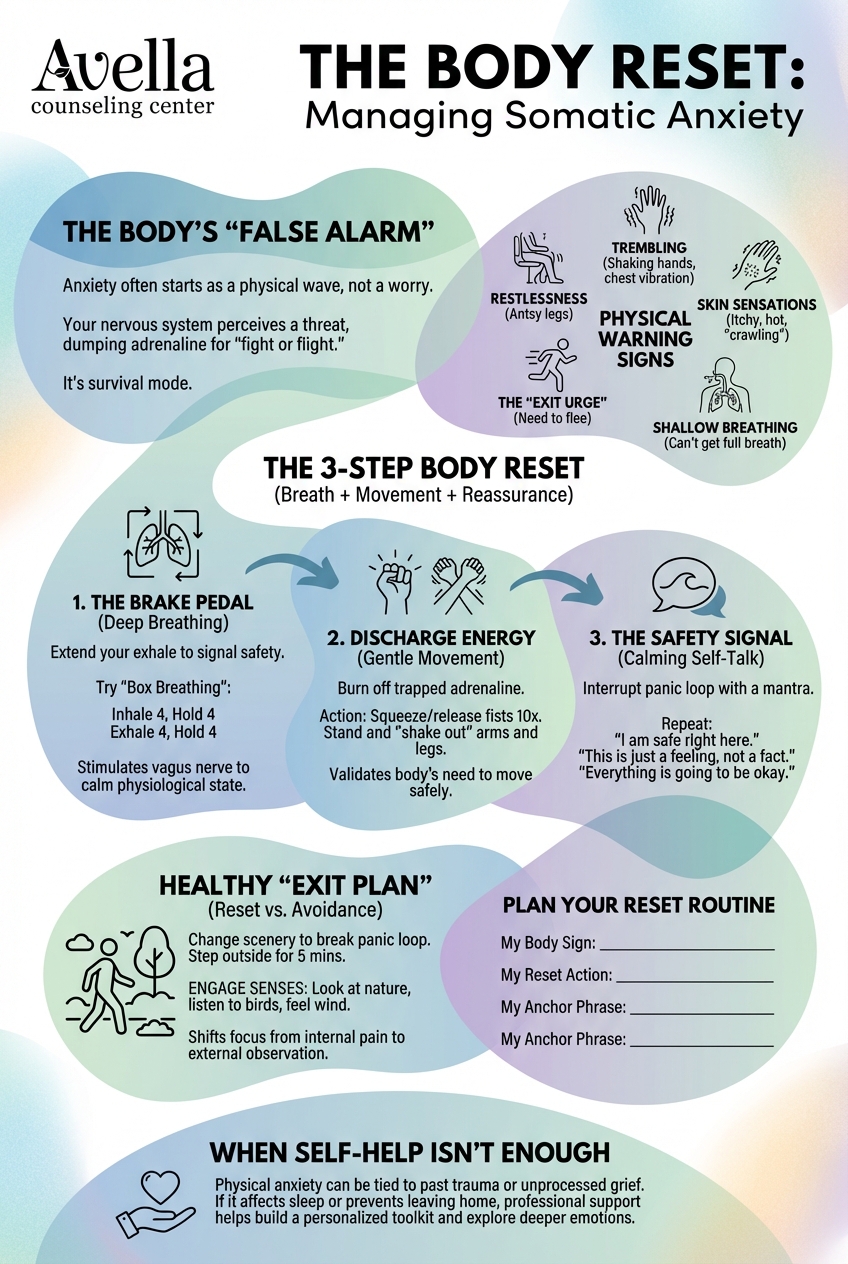
This is your body’s "False Alarm." Your nervous system has perceived a threat—even if there isn't one—and has dumped adrenaline into your bloodstream to prepare you to fight or flee. This biology explains why you feel shaky or restless; your body is literally revving its engine to run from a tiger that isn't there.
According to the American Psychological Association, this "fight, flight, or freeze" response affects nearly every system in your body, from your muscles to your breathing.
Common Physical Warning Signs
If you catch anxiety here, before the racing thoughts start, you can manage it much faster. Watch for these signs:
- Restlessness: "Antsy" legs or an inability to sit still.
- Trembling: Shaking hands or a vibrating feeling in your chest.
- Skin Sensations: Feeling itchy, hot, or like your skin is crawling.
- The "Exit Urge": A sudden need to go outside or leave a social situation.
- Shallow Breathing: Feeling like you can’t get a full breath.
The 3-Step Body Reset
When the physical symptoms of anxiety hit, you need to burn off that excess energy and signal safety to your brain. I teach a sequence called Breath + Movement + Reassurance.
Step 1: The Brake Pedal (Deep Breathing)
When you are anxious, you likely take short, shallow breaths. This keeps the panic loop going. To stop it, you need to extend your exhale.
- Action: Try "Box Breathing." Inhale for 4 counts, hold for 4, exhale for 4, and hold empty for 4.
- Why it works: Slow, rhythmic breathing stimulates the vagus nerve, which tells your brain, "We are safe; you can turn off the alarm now." Harvard Health explains that deep breathing effectively changes your physiological state from alert to relaxed.
Step 2: Discharge the Energy (Gentle Movement)
Anxiety is trapped energy. If your hands are shaking or you feel restless, it’s because you have adrenaline waiting to be used. Don't fight the shake—use it.
- Action: Try squeezing your hands into tight fists as hard as you can, then releasing them quickly. Do this 10 times. You can also stand up and "shake out" your arms and legs, or wiggle your toes vigorously.
- Why it works: This creates a controlled release for that physical tension. It validates what your body wants to do (move) but does so in a safe, contained way.
Step 3: The Safety Signal (Calming Self-Talk)
Once you have breathed and moved, your brain is ready to listen. Now you can use a "safety signal" or mantra.
- Action: Repeat a simple phrase like, "I am safe right here," "This is just a feeling, not a fact," or "Everything is going to be okay."
- Why it works: Anxiety lies to you and says you are in danger. Hearing your own voice speak calm, definitive words helps interrupt the spiral of negative thoughts.
Creating a Healthy "Exit Plan"
Sometimes, you just need to change your scenery to break the panic loop. There is a big difference between avoidance (running away from life because of fear) and resetting (taking a strategic break to return stronger).
If you feel the walls closing in, give yourself permission to step outside for 5 minutes.
- Engage your senses: Don't just go outside and look at your phone. Look at nature. Listen for birds. Watch a dog walking down the street. Feel the wind on your face.
- The Shift: By focusing on the birds or the trees, you shift your brain from internal monitoring (scanning your body for pain) to external observation. This grounds you in the present moment.
Read more about distinguishing healthy distraction from avoidance here.
Worksheet: Your Personal Reset Routine
You can’t learn a fire drill while the house is burning. Plan your reset routine now so it’s ready when you need it.
- My Body Sign: (e.g., My hands start shaking and my chest feels tight.)
- My Reset Action: (e.g., I will step into the backyard and squeeze/release my fists 10 times.)
- My Anchor Phrase: (e.g., "I am safe. This will pass.")
When Self-Help Isn't Enough
While these grounding techniques are powerful for managing symptoms in the moment, they don't always resolve the root cause of the anxiety.
Sometimes, physical anxiety is tied to past trauma or unprocessed grief and loss. If you find that anxiety is affecting your sleep (causing vivid dreams or insomnia) or preventing you from leaving your home, professional support can help.
Therapy isn't just about "venting." It is a space to practice these skills until they become muscle memory, and to gently explore the deeper emotions fueling the physical alarm.
Start Your Reset Today
You don't have to live at the mercy of your physical symptoms. If you feel like your body is constantly in alarm mode, I can help you build a personalized toolkit to reclaim your calm.
Anamile Guerra, LPC-Associate
Supervised by Jennifer Gonzalez, MS, LPC-S and Amanda Varnon, MA, LPC-S
Schedule a Consultation with Anamile
Frequently Asked Questions
Why does anxiety make me shake?
Shaking is a result of adrenaline. Your body is preparing muscles for "fight or flight." When you don't actually run or fight, that energy manifests as trembling or shaking.
Can anxiety cause itching?
Yes. Stress responses can activate nerve fibers and release histamines, leading to itching, flushing, or a "crawling" sensation on the skin without any rash present. Mayo Clinic notes that anxiety can present with a wide variety of physical symptoms.
Is it okay to leave a room when I panic?
Yes, if you do it intentionally. Stepping out to "reset" (breathe, look at nature) with the intention of returning is a healthy coping skill. Leaving to avoid the situation entirely is avoidance. Therapy can help you tell the difference.