You might tell your friends and family that you are doing "fine." And in a way, you are. You have curated a daily routine that feels manageable. You go to work, you come home, and you stay there.
But if you look closely, you might notice your world has quietly shrunk. Maybe you used to enjoy browsing the grocery store, but now you only do curbside pickup. Maybe you turn down invitations because the thought of driving at night or being in a crowd feels overwhelming.
As a therapist, I often see this pattern. It usually isn't a dramatic refusal to ever leave the house. Instead, it’s a slow process of avoiding triggers until your "safe zone" becomes very small.
If you are dealing with anxiety leaving the house or recovering from a distressing event, the goal isn't to force yourself into terrifying situations tomorrow. The goal is to use gentle, realistic exposure to reclaim your freedom—one small step at a time.
How Avoidance Grows (And Why It Tricks You)
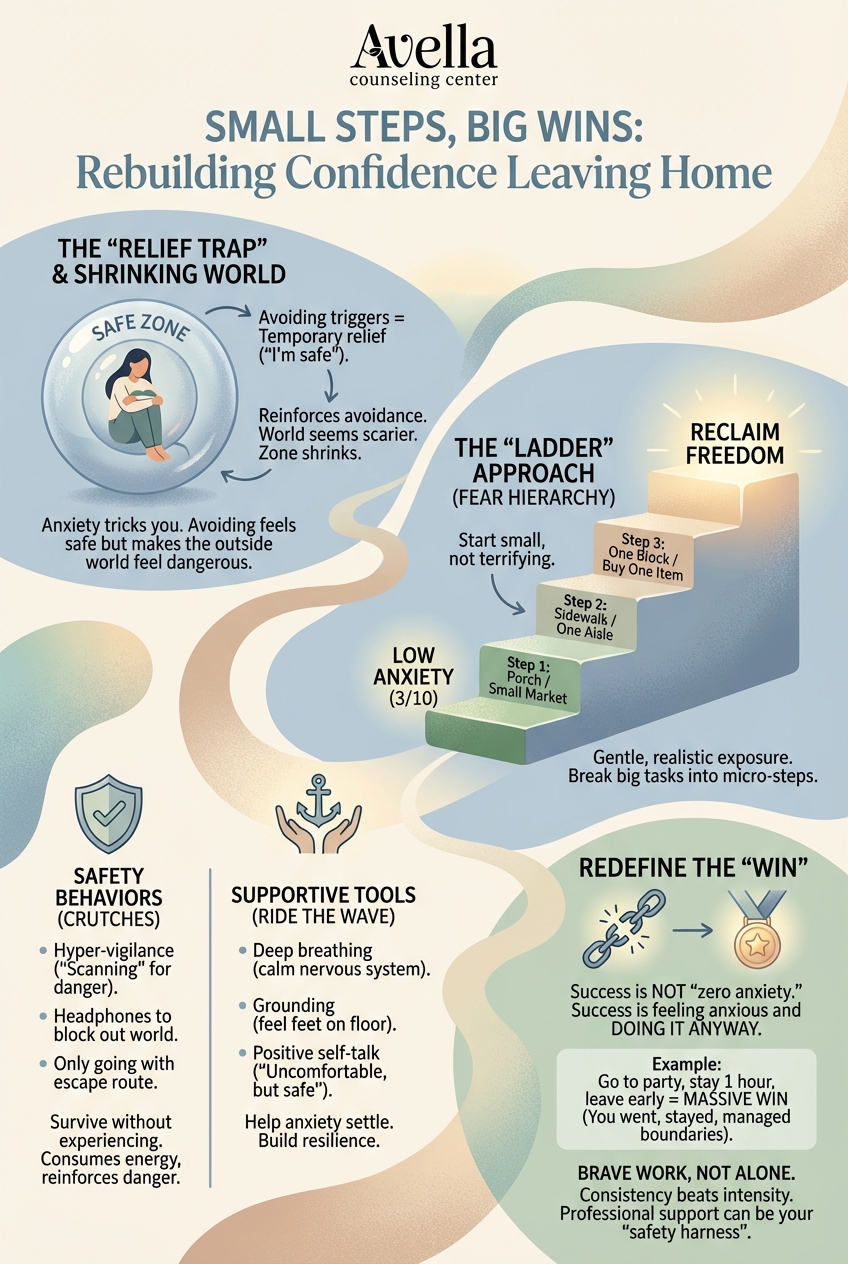
Anxiety is a master of trickery. Its favorite trick is the "relief trap."
Imagine you are invited to a party. Your heart starts racing, and your chest gets tight. You decide to stay home instead. Immediately, your anxiety drops. Your brain registers this relief and learns a powerful lesson: “Avoiding that situation kept me safe.”
Over time, this creates a cycle. The more you avoid, the scarier the outside world seems because you never give yourself the chance to see that you can handle it.
External factors can make this harder. When you see distressing news or receive safety alerts on your phone, it can validate your fears. You might feel a physical reaction—like a lump in your throat or a tightness in your chest—even when you are sitting safely in your living room. This makes it difficult to distinguish between actual danger and anxiety-driven avoidance.
The ‘Ladder’ Approach: Creating Your Personal Plan
To break the cycle, we don't jump off a cliff; we climb a ladder. In therapy, we often call this a "Fear Hierarchy." You start with steps that cause mild annoyance (a 3 out of 10 on the anxiety scale) rather than terror (a 10 out of 10).
Here is how you can apply this to real life:
Example 1: The Grocery Store
If a large superstore feels overwhelming, don't force yourself to do a full weekly shop there.
- Step 1: Go to a smaller, familiar market during a quiet time.
- Step 2: Walk aisle-by-aisle without the pressure to buy a full cart of groceries. Maybe just buy one item, like a pack of cookies.
- Step 3: Observe your anxiety levels. Did the anticipation feel worse than actually being there?
Example 2: Walking the Dog
If walking around the neighborhood feels unsafe or exposing:
- Step 1: Put the leash on your pet and just walk to the porch. Stand there for two minutes, then go back inside.
- Step 2: Next time, walk to the sidewalk and back.
- Step 3: Eventually, try walking just one block.
By breaking big tasks into these micro-steps, you prove to your brain that you can leave your safe zone and return home unharmed.
Safety Behaviors vs. Supportive Tools
When you start going out again, it is important to notice how you are doing it. Are you using coping mechanisms that help you, or "safety behaviors" that keep you stuck?
What are Safety Behaviors?
These are crutches we use to survive a situation without really experiencing it. A common one is hyper-vigilance or "scanning."
- You might find yourself looking at the face of every person in a store, trying to analyze their expression to see if they are "safe" or "unsafe."
- You might wear headphones to block out the world completely.
- You might only go out if you have an immediate "escape route."
While these make you feel safer in the moment, they consume a massive amount of mental energy and reinforce the idea that the environment is dangerous.
What are Supportive Tools?
These are strategies that help you ride the wave of anxiety until it settles.
- Deep breathing: calming your nervous system when you feel that lump in your throat.
- Grounding: Feeling your feet on the floor rather than scanning the crowd.
- Positive self-talk: Reminding yourself, "I am uncomfortable, but I am safe."
For more on managing these feelings, you can read about when the news triggers your anxiety.
The After-Action Review: Progress Over Perfection
One of the biggest hurdles to rebuilding confidence after trauma is perfectionism. We often think success means "feeling zero anxiety."
That is not the goal. Success is feeling anxious and doing it anyway.
Redefining the "Win"
Let's say you go to a social gathering. You stay for an hour, but then you feel a spike of anxiety—maybe regarding driving home in the dark—so you leave early.
- The Anxiety Voice says: "You failed. You had to leave."
- The Reality: You went. You stayed for an hour. You managed your boundaries and got yourself home safely. That is a massive win.
After you get home, take a moment for somatic awareness. Check in with your body. Did the racing heart or the tightness in your throat eventually settle down once you were back in your safe space? Noticing that your body can return to calm is a vital part of the healing process.
A Weekly Practice Plan (5–15 Minutes)
You don't need to dedicate hours to this. Consistency beats intensity.
- The "Dreaming" Phase: Before you sleep, try visualizing yourself going to a specific place. Imagine walking through the door, feeling calm, and completing your task. This "primes" your brain for success.
- Monday – Thursday: Pick low-stakes practice. Walk around your apartment complex, sit on a park bench for 5 minutes, or walk the dog just to the edge of the property.
- The Weekend: Try a slightly higher challenge. Visit a store during off-peak hours or visit a friend for a brief coffee.
If you find yourself using distractions to get through these moments, it might be helpful to understand the difference between healthy distraction vs. avoidance.
You Don't Have to Climb the Ladder Alone
Rebuilding confidence is a marathon, not a sprint. There will be days when the anxiety feels heavier, and that is okay. The fact that you are trying to expand your world again is brave work.
If you feel stuck at the bottom of the ladder, or if fear of going out (agoraphobia) is impacting your daily life, professional support can provide the safety harness you need. Therapy can help you distinguish between real instincts and trauma responses, allowing you to live a larger, freer life.
For more resources on anxiety disorders and exposure strategies, the National Institute of Mental Health (NIMH) offers helpful overviews, and the American Psychological Association provides excellent information on how exposure therapy works.
Ready to start your personalized plan?
If you are in Texas and looking for support, Anamile Guerra, LPC-Associate, is here to help you navigate anxiety and trauma with compassion and practical tools.
Contact Anamile Guerra at Avella Counseling today to schedule a consultation.