You get up, you go to work, you smile at your coworkers, and you come home to your family. On the outside, everything looks functional. You are doing all the right things. But on the inside, it feels like there is nobody home.
Clients often describe this experience as "robot mode" or living in a "blank space." It’s the sensation of going through the motions of parenting or working, only to look back at the end of the day and realize you have almost no memory of the emotional experience. You might find yourself reacting to bad news with a simple emoji not because you don’t care, but because you physically cannot summon the energy to find the words.
When this happens, it is easy to spiral into shame. You might tell yourself you are being lazy, ungrateful, or cold.
But this emotional "nothingness" is rarely a character flaw. In therapy, we often identify this state not as a lack of feeling, but as a high-level protective mechanism designed to shield you from overwhelming stress or grief.
Signs You’re Stuck in "Autopilot" (And Why It’s Not Laziness)
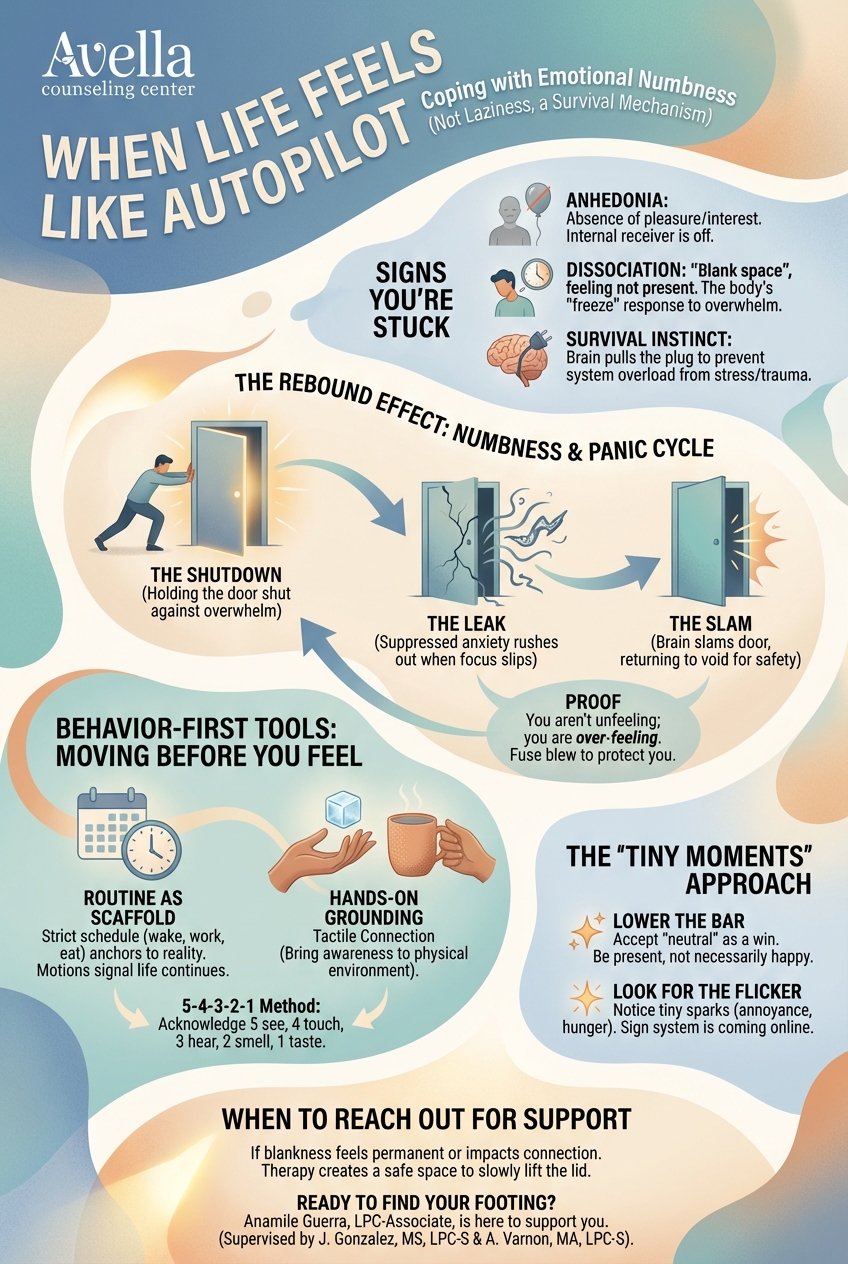
Emotional numbness often feels like a vacuum. It isn't necessarily sadness; sadness is a feeling. This is the absence of feeling. Clinicians often refer to this inability to feel pleasure or interest in things you once enjoyed as anhedonia. It’s not that you are bored; it’s that your internal receiver has been turned off.
You might notice that you are completing tasks—driving, sitting at your desk, folding laundry—but your mind feels like a white wall. You aren’t present. This disconnect is what mental health professionals often refer to as dissociation or the "freeze" response.
It is crucial to distinguish this from laziness. Laziness is usually a choice; you simply don't want to do something. Autopilot is a survival instinct.
Most of us are familiar with the "fight or flight" response, but the body has a third option when fighting or fleeing feels impossible: the freeze response. According to Harvard Health, this stress response is hardwired into our biology to protect us from perceived threats. When the brain has processed too much—whether it is recent grief, chronic financial stress, or past trauma—it eventually pulls the plug to prevent a system overload.
NAMI (National Alliance on Mental Illness) notes that dissociation is often a way the mind copes with too much stress. Your brain decides that feeling nothing is safer than feeling the pain that is waiting at the door.
The Rebound Effect: Why Numbness and Panic Often Coexist
One of the most confusing aspects of emotional numbness is that it often sits right next to high anxiety. You might feel totally blank one minute, and then suddenly feel a rush of panic—tingling hands, a racing heart, or a sense of doom—the next.
This is the rebound effect. Think of your emotions as being behind a heavy door that you are holding shut.
- The Shutdown: You feel numb because you are pressing all your weight against that door to keep the "dark hole" of depression or grief from opening up.
- The Leak: When your focus slips or you try to relax, the door cracks open, and all that suppressed anxiety rushes out at once.
- The Slam: Because that sudden anxiety is terrifying, your brain slams the door shut again, returning you to the safety of the void.
This cycle proves a vital point: You aren't unfeeling. You are actually over-feeling, and your fuse has blown to protect you.
Behavior-First Tools: Moving Before You Feel
When you are in autopilot mode, waiting for motivation doesn't work. You likely won't "feel like" engaging with the world. Instead, you have to move the body first, and hope the feelings eventually follow.
The Power of Routine
When internal motivation is gone, external structure acts as a scaffold. Keeping a strict schedule—wake up, shower, work, eat—might feel mechanical, but it keeps you anchored to reality. It prevents the void from becoming a permanent state of inertia. Even if you are just going through the motions, those motions matter because they signal to your brain that life is continuing.
Hands-On Grounding (Tactile Connection)
Cognitive strategies (thinking your way out of it) often fail when you are numb because your "thinking brain" (the prefrontal cortex) is offline. Instead, try connecting through your hands using specific grounding techniques designed to bring your awareness back to the physical environment.
Many people find relief in mechanical or tactile tasks. This could look like:
- The 5-4-3-2-1 Method: Acknowledge 5 things you see, 4 things you can touch, 3 things you hear, 2 things you can smell, and 1 thing you can taste. This forces your brain to process sensory input rather than internal loops.
- Temperature Therapy: Holding an ice cube until it melts or wrapping your hands around a warm mug. The extreme sensation demands attention from your nervous system.
- Manual Labor: Fixing something, gardening, or organizing—using your hands to manipulate the physical world helps you feel "solid" again.
These small, physical actions bridge the gap between your mind and the physical world. They remind your brain, "I am here. I am solid. I am safe."
The "Tiny Moments" Approach to Reconnection
When we feel dead inside, the temptation is to do something huge to force ourselves to feel alive. You might feel the urge to book an expensive trip, go to a loud concert, or make a drastic life change, hoping the adrenaline will shock your system back to normal.
This often backfires.
High-stakes events create pressure. If you go to the big event and still feel numb, it confirms your worst fear: "Something is broken in me."
Instead of looking for a flood of joy, try healthy distraction and "micro-dosing" emotions.
- Lower the bar: Accept "neutral" as a win. You don't need to be happy today; you just need to be present.
- The 2-Minute Practice: Once a day, stop and notice one thing you see and one thing you touch.
- Look for the flicker: If you feel a tiny spark of annoyance, hunger, or amusement, acknowledge it. That is a sign your system is coming back online.
When to Reach Out for Support
Living on autopilot is a valid survival strategy for a short time, but it becomes problematic when it starts impacting your ability to connect with your spouse or children, or when the "blankness" starts feeling permanent.
If you are oscillating between feeling nothing and feeling sudden anxiety, therapy can help. In counseling, we don't force the door open. We create a safe environment to slowly lift the lid on the vacuum so emotions can be processed gradually, rather than rushing out as panic.
You do not have to navigate the void alone. Reconnecting with yourself is a process, and it is okay to ask for help along the way.
Ready to Find Your Footing?
If you are tired of feeling disconnected, Anamile Guerra, LPC-Associate, is here to support you. Supervised by Jennifer Gonzalez, MS, LPC-S, and Amanda Varnon, MA, LPC-S, Anamile offers a safe, non-judgmental space to explore what is happening beneath the surface.