

Living with frequent conflict often feels like walking on eggshells. You might wake up feeling exhausted, even after a full night’s sleep, because your body is constantly bracing for the next explosion. You may find yourself trying to predict your partner's mood the moment they walk through the door, adjusting your behavior just to keep things calm.
It is physically and emotionally draining to live in a state of high alert. In my work with clients here in Pearland, I often see people who are trying desperately to "fix" the argument by explaining their side, hoping that if they just find the right words, the other person will understand.
But what if the goal shifted? What if, instead of trying to win the argument or force an understanding, your goal became protecting your nervous system? This shift doesn't mean you agree with hurtful behavior; it means you are choosing to prioritize your peace over a circular battle.
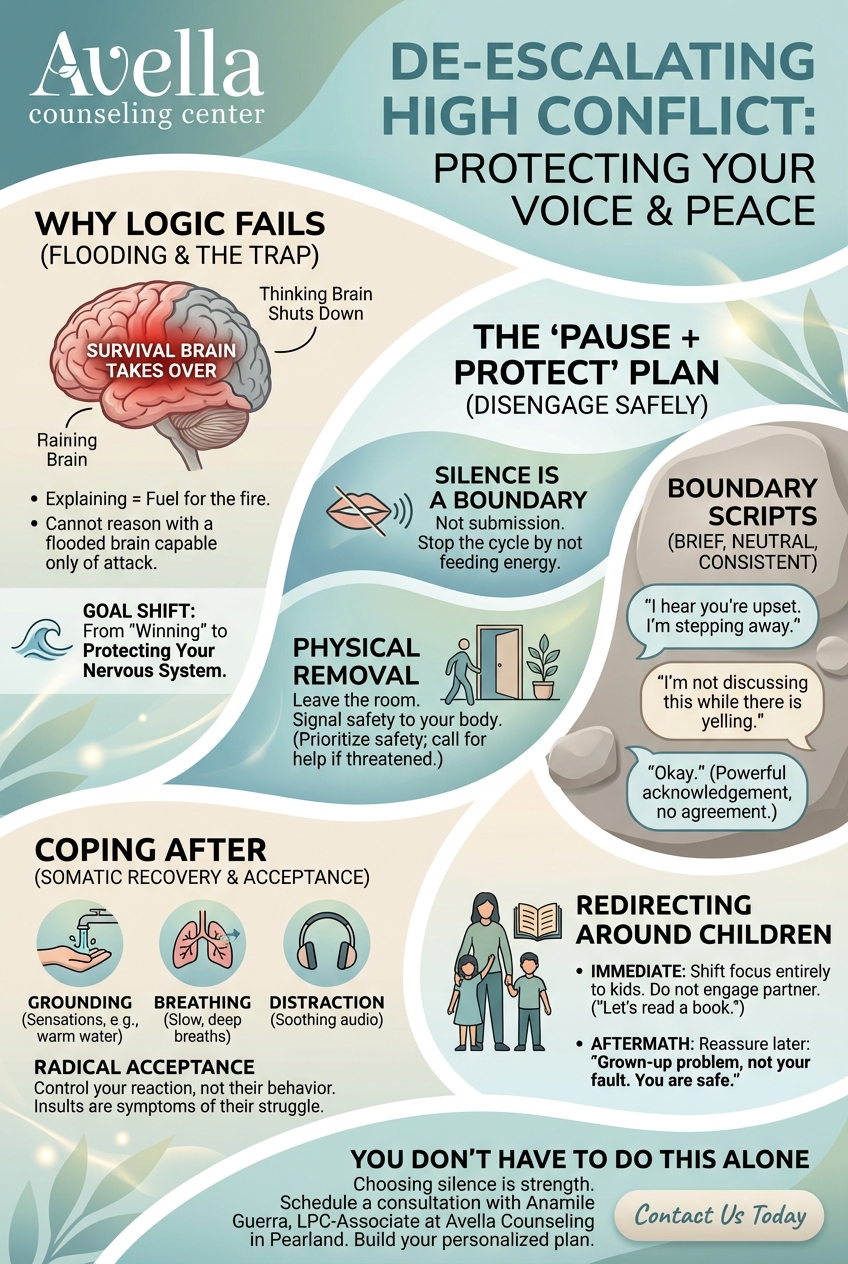
Why Logic Stops Working: Signs of Escalation
Have you ever noticed that the more you try to explain yourself during a yell-fest, the worse it gets? This isn't just frustration—it is biology.
When someone escalates—raising their voice, using insults, or becoming aggressive—their brain undergoes a physiological shift. The "thinking" part of the brain (the prefrontal cortex) shuts down, and the survival brain takes over. This is often called "flooding."
The Trap of Explaining
When you ask questions like "Why are you acting like this?" or try to defend yourself with logic, you are trying to use reason with a brain that is currently incapable of reasoning. In many high-conflict dynamics, your defense acts as fuel for the fire. It gives the escalating person more material to twist or argue against.
Recognizing the Point of No Return
If the conversation has shifted from solving a problem to attacking your character, or if you feel your heart racing and your stomach turning, the productive part of the conversation is over. Continuing to engage usually leads to more pain, not a resolution.
The ‘Pause + Protect’ Plan: How to Disengage Safely
One of the hardest but most effective changes you can make is to stop pleading. Meaningful change often happens when you stop begging for the behavior to stop ("Please don't be mad," "Please listen") and simply remove yourself from the situation.
The Power of Silence
Silence is not submission. In a high-conflict moment, silence is a boundary. By not feeding the argument with your energy, you stop the cycle of escalation. You are essentially stepping out of the tennis match; if you don't hit the ball back, the game cannot continue.
Physical Removal
If possible, physically leave the room. Engaging in a neutral, grounding activity—like cleaning, cooking, or listening to a podcast—can help signal to your body that you are safe and that you are not participating in the chaos.
Note: If escalation ever threatens your physical safety, leaving the premises or calling for help is the priority. You can contact the National Domestic Violence Hotline for confidential support and safety planning.
Boundary Scripts That Don’t Invite More Arguing
When you decide to disengage, you need a script. If you say too much, it opens a debate. If you say it with sarcasm, it invites a fight. The key is to be brief, neutral, and consistent. This concept is often related to the "Gray Rock" method—becoming as uninteresting and unreactive as a rock.
Sample Scripts to Practice:
- The Exit: "I hear that you are upset. I am going to step away now."
- The Boundary: "I’m not going to discuss this while there is yelling."
- The Acknowledgement: "Okay."
The power of a simple "Okay" is immense. It acknowledges you heard them without agreeing with their insults or accusations. Eventually, when the aggressor realizes they cannot get a rise out of you, they may tire of the conflict sooner.
When Little Eyes Are Watching: Redirecting Around Children
It is heartbreaking when a partner insults you or speaks negatively about family members in front of the children. Your instinct might be to correct the lie immediately to protect your image or the truth. However, fighting back in that moment often scares the children more.
Immediate Action: Redirect
If an argument starts in front of the kids, shift your focus entirely to them. Do not engage with the partner. Calmly direct the children to another activity.
- "Let’s go to your room and read a book."
- "It is time for bed, let's go brush teeth."
The Aftermath Talk
You can repair the moment with your children later when things are calm. You don't need to bad-mouth the other parent to validate your child's experience.
- "I know there was a lot of loud noise earlier. That was a grown-up problem, and it is not your fault. You are safe."
For more on supporting children through family stress, you might find our resources on parenting support helpful.
Coping After the Moment: Protecting Your Peace
Even if you successfully stay calm on the outside, your body absorbs the stress. This is why you might feel nausea, sudden fatigue, or the urge to cry after an argument. This is your nervous system's way of processing the adrenaline dump, a phenomenon often discussed in research regarding the fight or flight response.
Somatic Recovery
Instead of replaying the argument in your head, focus on your body.
- Grounding: Wash your dishes with warm water and focus on the temperature.
- Breathing: Take slow, deep breaths to tell your vagus nerve that the threat is over.
- Distraction: Put on headphones and listen to something educational or soothing to break the loop of negative thoughts.
Radical Acceptance
Peace often comes when we accept that we cannot change the other person’s behavior; we can only control our reaction. When you stop expecting them to be different, the insults may sting less because they are no longer a surprise—they are just a symptom of the other person's struggle.
Building Your Support System
When you are living in a high-conflict environment, it is easy to lose touch with reality. You may start to believe the negative things being said to you. This is why trusted outside voices—friends, family, faith communities, or a therapist—are vital. They act as a mirror, reminding you of who you really are.
You Don’t Have to Do This Alone
You do not have to attend every argument you are invited to. Choosing silence and disengaging is a strength, not a weakness. It is an act of self-preservation.
Navigating a high-conflict relationship is exhausting and can impact your physical health. If you are feeling stuck, anxious, or overwhelmed, support is available.
Schedule a consultation with Anamile Guerra, LPC-Associate, at Avella Counseling in Pearland. Together, we can build a personalized plan to help you regain your voice and protect your peace.