

For the first few weeks after a loss, you were a machine. You planned the funeral, managed the bank accounts, comforted your children, and thanked the neighbors for the casseroles. Everyone told you how strong you were. You might have even surprised yourself with how well you were holding it together.
But now, three, six, or even twelve months later, the adrenaline has worn off. The phone calls have stopped coming as often. The house is quiet. And suddenly, you feel like you are falling apart.
If this sounds familiar, you are likely experiencing delayed grief. It is a common experience for the "designated strong one" in the family. You aren't regressing, and you aren't failing. You are simply exiting "survival mode" and entering the processing phase.
Here is why the crash happens months later and how you can navigate it without losing yourself.
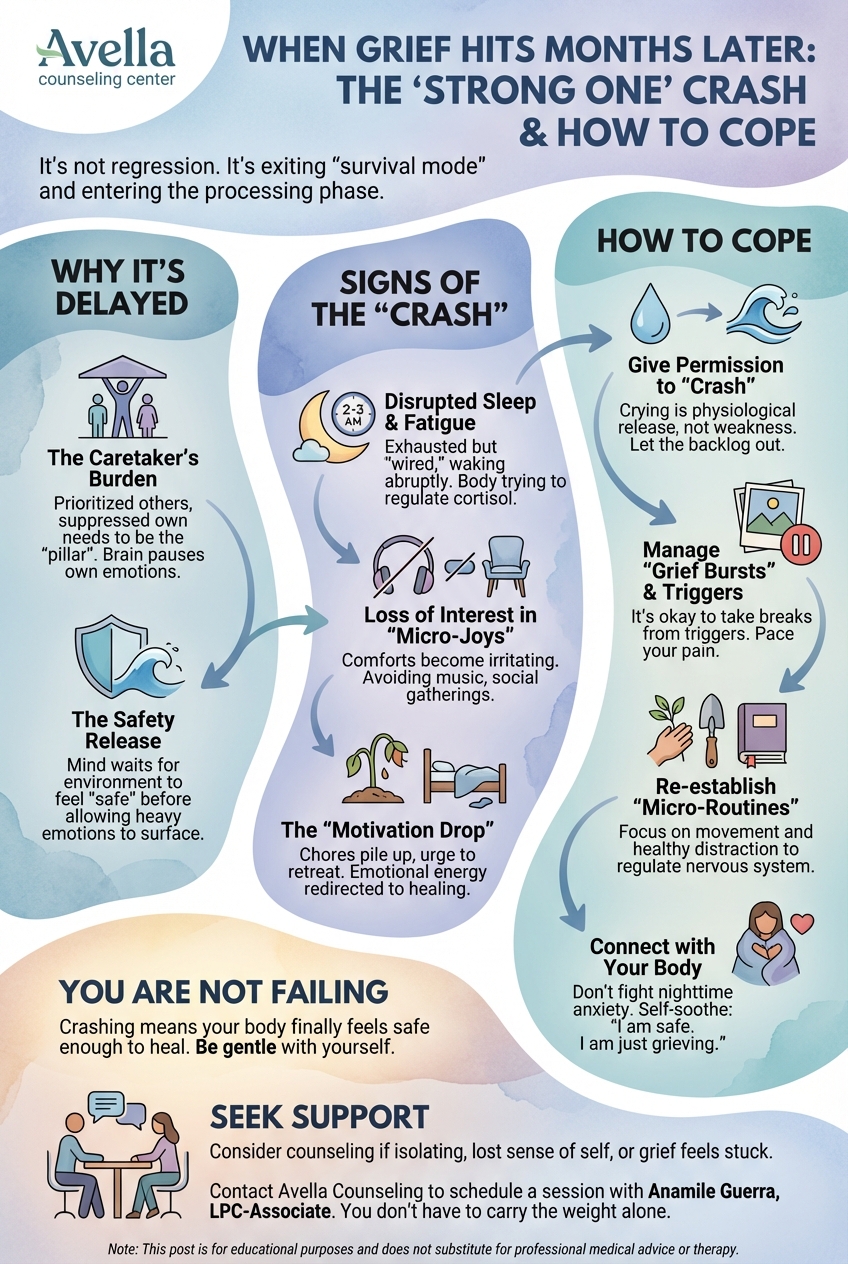
Why Grief is Often Delayed
When a tragedy strikes—especially a sudden one, like an unexpected accident—your brain enters a state of high alert. This is often called "survival mode." Your nervous system floods your body with stress hormones like cortisol and adrenaline to help you get through the crisis.
The Caretaker’s Burden
In therapy, we often see clients who prioritized everyone else's well-being over their own immediately after a death. For example, a surviving spouse might focus entirely on making sure their adult children and grandchildren are okay, suppressing their own tears to be the family "pillar."
As long as you feel that others rely on you to remain upright, your brain may unconsciously "pause" your own emotional needs.
The Safety Release
Your mind is protective. It often waits until your environment feels "safe" or stable before allowing the heavy emotions to surface. Once the estate is settled and the kids are back to their routines, your brain signals, "Okay, the crisis is over. Now we have to feel this." That is when the crash hits.
Signs You Are Exiting Survival Mode (and Entering Grief)
Delayed grief doesn't always look like weeping. Often, it looks like a sudden change in your ability to function.
Disrupted Sleep and Fatigue
You might find yourself exhausted all day, yet waking up abruptly at 2:00 or 3:00 AM. This is a common physical symptom of grief processing. The "tired but wired" feeling suggests your body is trying to regulate its cortisol levels now that the initial survival energy is depleting.
Loss of Interest in "Micro-Joys"
Things that used to bring you small comforts might suddenly feel irritating or painful.
- Music: You might stop listening to the radio in the car because music stirs up too much emotion. You might prefer silence because your internal world feels too loud.
- Socializing: You might find yourself avoiding phone calls or family gatherings you used to organize.
The "Motivation Drop"
Perhaps you were the person who cleaned the house daily or kept the yard perfect. Suddenly, you might find chores piling up. You might feel a strong urge to retreat to your bedroom early in the evening. This isn't necessarily laziness; it is a sign that your emotional energy is being redirected toward internal healing.
The Complexity of "The Strong One"
Grief is rarely simple. It is often complicated by the reality of relationships. We don't just grieve perfect relationships; we grieve real ones.
If you had a complex dynamic with the person who passed—perhaps there was deep love mixed with past arguments or "unfinished business"—your brain has to process all of that. You might feel sadness mixed with resentment, or love mixed with relief. This cognitive dissonance takes a lot of energy to sort through, which can further delay the grieving process.
The pressure to maintain the image of the "strong parent" or "strong spouse" can make you feel like you have to hide these complex feelings to protect your family's memory of the deceased.
How to Cope When the Wave Hits
If you are currently in the "crash" phase, trying to force yourself back into survival mode won't work. Instead, try these therapy-informed strategies.
1. Give Yourself Permission to "Crash"
Crying is a physiological release. It lowers blood pressure and releases toxins. If you have been holding it in for six months, you have a backlog. Let it out. It is not a sign of weakness; it is a sign of a working nervous system.
2. Manage "Grief Bursts" and Memory Triggers
Certain items—a digital photo frame, a view from the porch, or even seeing their favorite ice cream at the store—can trigger sudden, overwhelming emotion.
- The Strategy: It is okay to take a break from the triggers. If a photo frame makes you cry every time you walk by it, you can turn it off for a few hours. You aren't erasing them; you are pacing your pain.
3. Re-establish "Micro-Routines"
When motivation drops, big goals feel impossible. Focus on "tiring the body" in a healthy way to help with sleep.
- Movement: Engage in physical tasks like deep cleaning one room or gardening, not out of obligation, but to regulate your nervous system.
- Healthy Distraction: It is okay to distract yourself. Watching a gentle TV series or a movie that has nothing to do with your life can give your brain a necessary break from rumination. Healthy distraction is a valid coping tool.
4. Connect with Your Body
If you wake up with sudden anxiety in the middle of the night, try not to fight it. wrap yourself in a blanket, drink some water, and remind yourself: "I am safe. I am just grieving."
When to Seek Professional Support
While delayed grief is normal, you don't have to navigate it alone. You may want to consider counseling if:
- You are isolating completely (staying in your bedroom for days at a time).
- You feel like you don't know who you are anymore without the person you lost.
- The grief feels "stuck" due to complex feelings like guilt or anger.
Therapy can provide a space where you don't have to be the "strong one." It is an hour where you can be vulnerable without worrying about burdening your family.
You Are Not Failing
If you are crashing months later, it means your body finally feels safe enough to heal. Be gentle with yourself.
If you are struggling to function or process a complex loss, Anamile Guerra, LPC-Associate, is here to help. You don't have to carry the weight of being the "strong one" all by yourself.
Contact Avella Counseling today to schedule a session.
Note: This post is for educational purposes and does not substitute for professional medical advice or therapy.
Internal Resources:
External Resources: