

You finally handed in your resignation. You walked away from the yelling, the impossible deadlines, or the passive-aggressive emails. You thought leaving the job would fix everything. But weeks or even months later, the anxiety is still there.
You might find yourself panicking when a new, kind boss asks for a quick meeting. You might feel a lingering sense of dread on Sunday nights, even though you have nothing to fear on Monday morning.
As a therapist, I often see clients who feel they have "lost themselves" at work. They describe a lingering "fight or flight" response—a constant state of alert—that persists long after they are safe. This is because recovery isn’t just about changing your environment; it is about evicting the toxic boss from your mind.
If you are struggling to regain your footing after a difficult employment experience, here is a therapy-informed guide to rebuilding your self-worth.
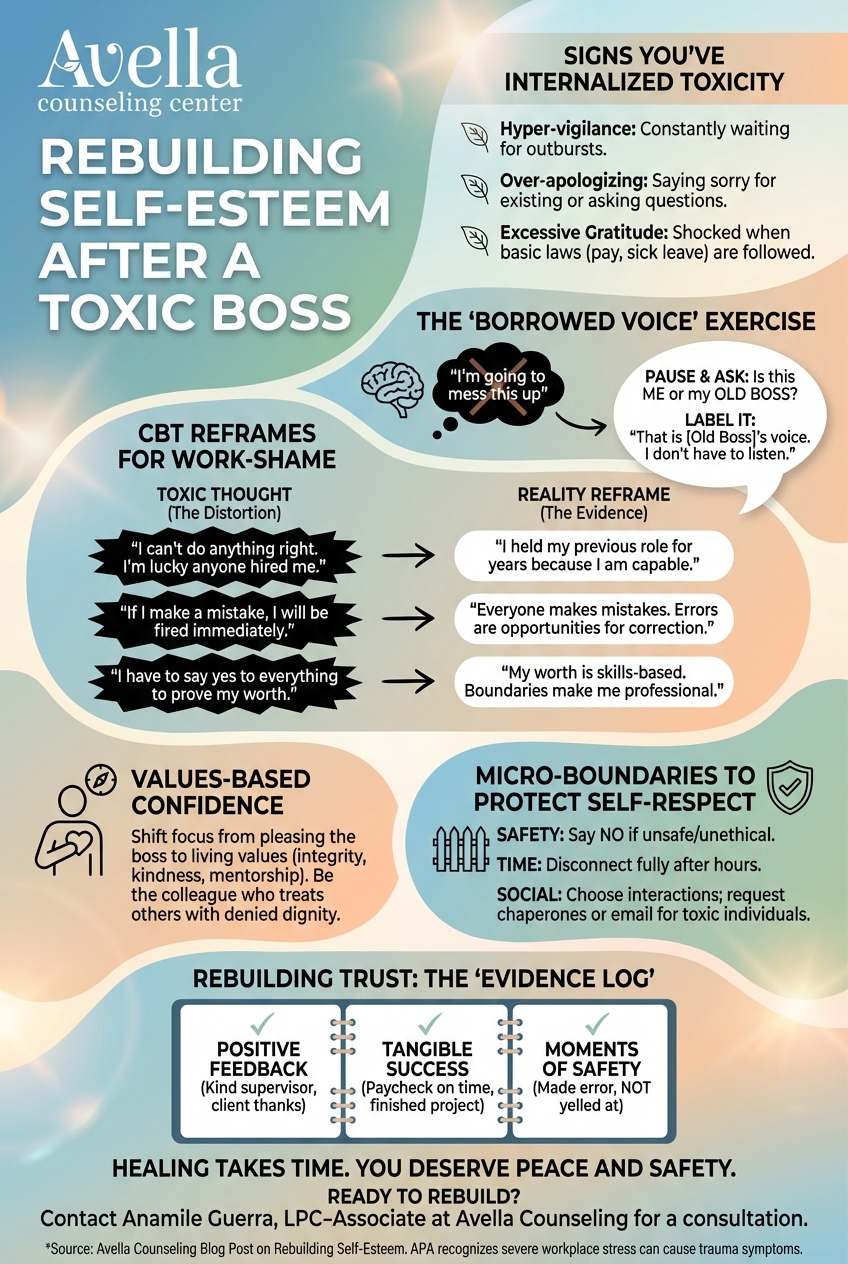
Signs You’ve Internalized a Toxic Environment
When you spend 40+ hours a week in an environment where you are devalued, your brain starts to accept that treatment as normal. According to the American Psychological Association, nearly one in five workers describes their workplace as toxic, a situation that significantly increases the risk of mental health harm.
Even when you move to a healthy workplace, you might experience "battered worker syndrome," where normal kindness feels suspicious or overwhelming.
Common signs you have internalized workplace abuse include:
- Hyper-vigilance: You are constantly waiting for the "other shoe to drop," expecting sudden outbursts or punishment.
- Over-apologizing: You say "I'm sorry" for asking questions, taking a sick day, or simply existing in the office.
- Excessive Gratitude for Basics: You feel shocked or tearfully grateful when a new employer simply follows the law—like paying you on time, allowing sick leave, or prioritizing safety protocols.
It is important to recognize that these reactions are normal responses to abnormal stress. They are not personality flaws; they are survival mechanisms that you no longer need.
The ‘Borrowed Voice’ Exercise: Separating Critics from Reality
Toxic managers often use personal insults to control employees. They might call you "useless," "slow," or make you feel like they are doing you a favor by employing you. Over time, you might start believing these insults are your own thoughts.
In therapy, we call this the Borrowed Voice. The negative thought in your head isn't actually yours; it is a recording of your old boss.
Try this exercise:
When a harsh thought pops up (e.g., "I'm going to mess this up"), pause and ask: "Is this me, or is this my old boss speaking?"
If you realize the tone matches your former critic, label it. Say to yourself, "That is [Old Boss]'s voice. I don't work for them anymore, and I don't have to listen to them anymore."
CBT Reframes for Common Work-Shame
Cognitive Behavioral Therapy (CBT) helps us challenge distorted thoughts with evidence. Toxic jobs thrive on making you feel incompetent so you won't leave. We need to look at the facts to break that illusion.
Here are common distortions and how to reframe them:
| The Toxic Thought | The Reality Reframe |
|---|---|
| "I can't do anything right. I'm lucky anyone hired me." | "I held my previous role for years because I am capable. If I were truly incompetent, I wouldn't have lasted that long." |
| "If I make a mistake, I will be fired immediately." | "Everyone makes mistakes. In a healthy workplace, errors are opportunities for correction, not abuse." |
| "I have to say yes to everything to prove my worth." | "My worth is based on my skills, not on overworking. Setting boundaries makes me a professional, not a slacker." |
One of the most powerful realizations for many clients is looking at their tenure. If you survived a high-pressure environment for 5, 10, or 12 years, you possess immense resilience and skill. The criticism was about their need for control, not your lack of ability.
Values-Based Confidence: Who Are You (Besides a Worker)?
Toxic workplaces often reduce you to a function—a cog in the machine. To rebuild self-esteem, you must remember who you are as a whole person.
Shift your focus from "pleasing the boss" to "living your values." Ask yourself:
- What kind of person do I want to be?
- Do I value integrity? Kindness? Mentorship?
For example, perhaps you were treated with disrespect. You can reclaim your power by deciding, "I will break the cycle. I will be the colleague who treats others with the dignity I was denied." When you act according to your own values rather than fear, confidence naturally returns.
Micro-Boundaries That Protect Self-Respect
You don't need to fight a war to feel safe again; you just need small fences, or "micro-boundaries." These prove to your brain that you are now in charge of your own safety.
- Safety Boundaries: If a task feels unsafe, unethical, or unprofessional (like being pressured to drink alcohol with a boss or ignore safety regulations), you have the right to say no.
- Time Boundaries: Make a habit of disconnecting fully after hours. This retrains your nervous system that "rest" is safe.
- Social Boundaries: You can choose who you interact with. If a certain task requires you to interact with a toxic individual, you can request a chaperone or communicate via email to keep a paper trail.
Establishing these boundaries without guilt is a vital step in teaching yourself that you deserve respect.
Rebuilding Trust with an ‘Evidence Log’
Your brain is wired to remember trauma—it is trying to protect you from getting hurt again. This means it might easily forget the good days. You have the right to manually input the "wins."
Keep a simple Evidence Log for two weeks. Write down:
- Positive Feedback: Did a supervisor check in on you kindly? Did a client thank you?
- Tangible Success: Did your paycheck arrive on time? Did you finish a project?
- Moments of Safety: Did you make a small error and not get yelled at?
Documenting these small moments of normalcy helps retrain your brain to recognize that you are safe, capable, and valued.
You Don’t Have to Navigate This Alone
Healing from a toxic job takes time. The voice of the critic will fade as you strengthen your own voice, but the transition can be heavy. You have the right to work in peace and safety, and you have the right to feel good about the skills you bring to the table.
If the voice of a past toxic boss is still dictating your anxiety today, support is available. Individual counseling can provide the tools you need to process workplace trauma and rebuild your professional identity.
Ready to rebuild your confidence?
Contact Anamile Guerra, LPC-Associate at Avella Counseling today to schedule a consultation. Together, we can work on leaving the toxicity in the past and moving forward with confidence.
Frequently Asked Questions
Is "workplace PTSD" a real thing?
While "workplace PTSD" isn't an official medical diagnosis in the DSM-5, the American Psychological Association (APA) recognizes that severe workplace stress, bullying, and harassment can cause symptoms identical to trauma, including anxiety, flashbacks, and avoidance.
How do I know if I need therapy for work stress?
If your work anxiety is affecting your sleep, your relationships outside of work, or your physical health (headaches, stomach issues), it may be helpful to speak with a professional. You can read more about when anxiety shows up in your body.
Can therapy help me if I was fired?
Yes. Being fired can be a major blow to self-esteem, even if it wasn't your fault. Therapy can help you process the event, separate your worth from your employment status, and prepare you for future interviews with renewed confidence.