

If you scroll through social media looking for advice on burnout, you will often find a common suggestion: "Just quit your job. Prioritize your peace. Leave toxic environments."
But let’s be real—for many people, quitting simply isn’t an option right now. You might be juggling multiple gigs to make ends meet, working irregular shifts to support a family, or holding onto a position because you need the benefits. When "just leaving" isn't a financial reality, standard self-help advice can feel frustrating and disconnected from your life.
As a therapist, I often work with clients who are dealing with burnout recovery while working. The exhaustion you feel isn't just about how hard you are working; it is often about temporal exhaustion—the lack of recovery time between shifts.
The good news is that you don't always have to overhaul your entire life to feel better. By treating burnout as a "systems problem"—managing energy, sleep, and small boundaries—you can often find relief even before life fully slows down.
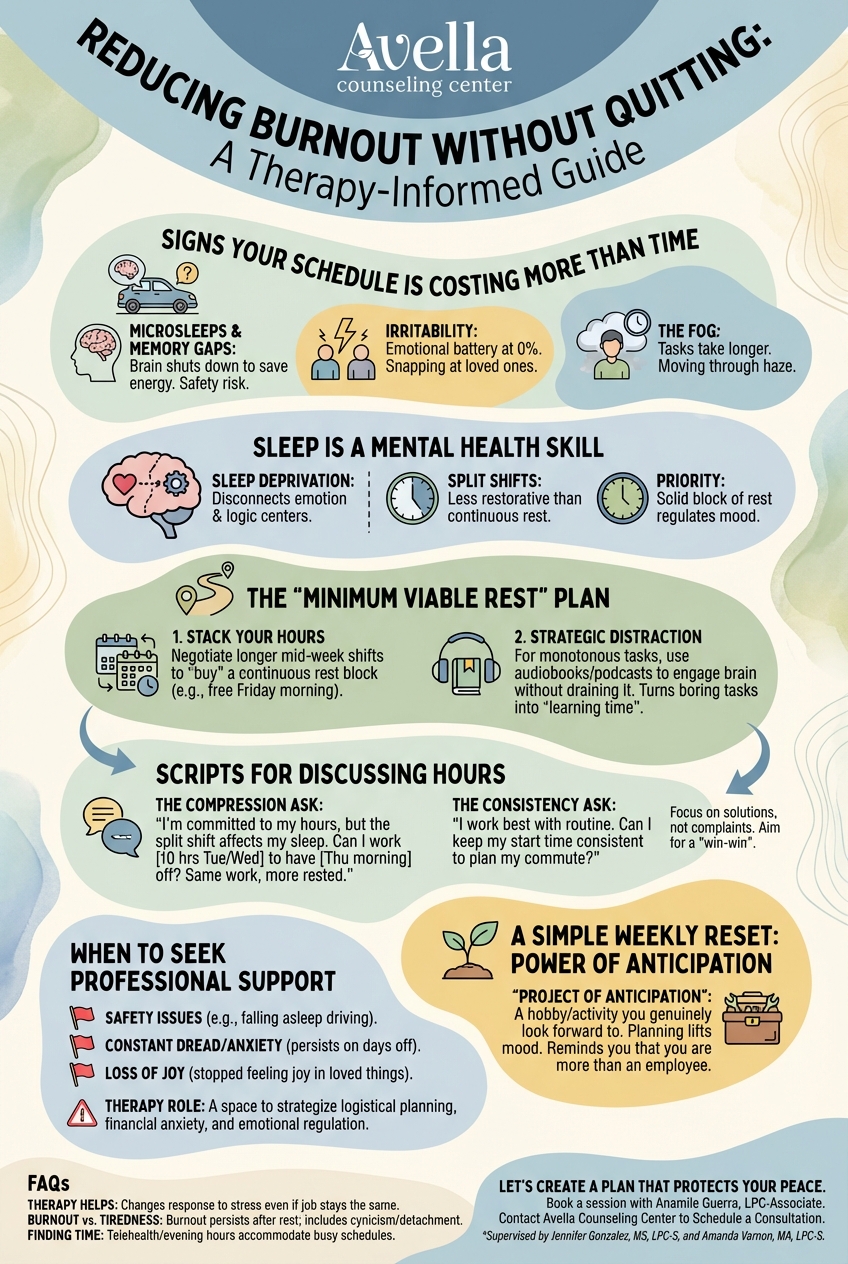
Signs Your Schedule Is Costing You More Than Time
When you are in survival mode, your brain tries to protect you by shutting down unnecessary functions. This often looks like "autopilot." You might physically be at work or at the dinner table, but your mind is miles away or completely blank.
One of the most dangerous signs of this is microsleeps or memory gaps. I have worked with individuals who drive home after a long double shift and suddenly realize they are in their driveway with no memory of the drive itself. This happens when the brain is so starved for rest that it begins to shut down perception to save energy.
Other signs include:
- Irritability with loved ones: You might snap at your partner or kids, not because you are angry, but because your emotional battery is at 0%. You are physically present, but you don't have the energy to engage in conversation.
- The "Fog": A sensation of moving through a haze where tasks that usually take 10 minutes now take 30.
- Monotony Dread: Feeling that every day is exactly the same, leading to a sense of hopelessness.
If you feel like you are just going through the motions, you might be dealing with emotional numbness.
Why Sleep Is a Mental Health Skill (Not a Luxury)
We often view sleep as "downtime"—something we do when we have nothing else to do. However, from a mental health perspective, sleep is emotional maintenance.
The Sleep Foundation notes that sleep deprivation creates a disconnect between the amygdala (the emotional center of the brain) and the prefrontal cortex (the logical part). This is why everything feels like a catastrophe when you are tired.
For shift workers, the "split shift" is particularly hard. Sleeping for three hours in the morning and three hours in the evening does not offer the same restorative benefits as a continuous block of rest. You might find yourself trying to force sleep at 9:00 AM when the rest of the world is waking up, leading to frustration and further exhaustion. Prioritizing a solid block of sleep isn't lazy; it is the single most effective tool for regulating your mood.
The “Minimum Viable Rest” Plan
If a two-week vacation isn't possible, we need to look for "micro-recoveries." This involves looking at your weekly schedule like a math problem to find small pockets of time you can reclaim.
1. Stack Your Hours (If Possible)
Sometimes, working a slightly longer day on Wednesday and Thursday can "buy" you a free Friday morning. I have seen clients successfully negotiate staying two extra hours on mid-week shifts specifically so they could leave early on a Friday. This didn't change their total income, but it changed the distribution of their rest, allowing them to sleep continuously for one full night.
2. Strategic Distraction
If your work involves repetitive, monotonous tasks (like driving, cleaning, or stocking), your brain might be exhausted from boredom. This is a great time for healthy distraction.
Listening to audiobooks, podcasts, or interesting YouTube videos (audio only) while you work can keep your mind engaged without draining it. It can turn a boring four-hour task into "learning time," which helps reduce the feeling that you are wasting your life at work.
For more on this, read about when staying busy helps and when it doesn't.
Scripts: How to Discuss Hours Without Conflict
Many people are afraid to set boundaries with a boss because they fear losing shifts. The key is to present a solution rather than a complaint. This is about setting boundaries without guilt.
Here are a few scripts you might adapt:
- The Compression Ask: "I'm really committed to getting my hours in, but the current split shift is affecting my sleep. Could I work 10 hours on Tuesday and Wednesday so I can have Thursday morning off? I'll get the same amount of work done, but I’ll be more rested."
- The Consistency Ask: "I work best when I have a routine. Is it possible to keep my start time consistent next month? It helps me plan my commute and be here on time."
When you approach a manager with a plan that ensures the work still gets done, it often becomes a "win-win" conversation.
A Simple Weekly Reset: The Power of Anticipation
When you finally get a day off, it is tempting to spend the entire day running errands or paying bills. While chores are necessary, they are not restorative.
To combat the feeling that "all I do is work," you need a "project of anticipation." This is a hobby or activity that you genuinely look forward to—building a craft, working on a garden, or reading a specific book series.
Even if you only have 30 minutes a week to work on it, the mere act of planning for it can lift your mood during a hard shift. Knowing you have something creative waiting for you at home reminds you that you are more than just an employee.
When to Seek Professional Support
Sometimes, schedule adjustments aren't enough. You may want to consider professional support if:
- You are experiencing safety issues (like falling asleep driving).
- You feel a constant sense of dread or anxiety that doesn't go away on your day off.
- You have stopped feeling joy in things you used to love.
According to the American Psychological Association (APA), chronic work stress is linked to long-term health issues. Therapy isn't just about "venting." It is a space to strategize. We can work on logistical planning, financial anxiety, and emotional regulation techniques to help you navigate this season of life.
Frequently Asked Questions
Can therapy help if I can't change my job?
Yes. Even if your external circumstances stay the same, therapy can help you change how you respond to stress, manage your energy, and protect your emotional well-being so you don't burn out completely.
Is it burnout or just tiredness?
Tiredness usually goes away after a good night's sleep. Burnout is a deeper sense of physical, emotional, and mental exhaustion that persists even after you've rested. It often includes feelings of cynicism or detachment from your job.
How do I find time for therapy with a busy schedule?
Many therapists offer telehealth (video) sessions or evening hours to accommodate working professionals. This eliminates travel time and makes it easier to fit a session into a break or after work.
Let’s Create a Plan That Protects Your Peace
You do not have to figure out this puzzle alone. If you are feeling overwhelmed by the demands of work and life, I can help you find clarity and balance.
Book a session with Anamile Guerra, LPC-Associate. Together, we can develop practical strategies to manage stress and burnout, ensuring you can take care of yourself while taking care of your responsibilities.
[Contact Anamile Guerra to Schedule a Consultation]
Anamile Guerra is a bilingual Licensed Professional Counselor Associate supervised by Jennifer Gonzalez, MS, LPC-S, and Amanda Varnon, MA, LPC-S.