You might know the feeling: waking up every morning with a pit in your stomach, immediately checking your phone for an email or checking the mailbox for a letter that hasn’t arrived. You feel like you are pressing "pause" on your dreams while you wait for a judge, a lawyer, or a government agency to make a decision about your future.
This state of "limbo" is exhausting. It is not just normal stress; it is a suspension of your life’s timeline. Whether you are navigating a complex visa process, waiting on a VAWA case, or dealing with family court delays, the uncertainty can feel paralyzing.
As a therapist, I often work with clients who feel stuck in this waiting room of life. While you cannot control the legal timeline or the speed of the bureaucracy, you can control how you navigate the wait. Here is how to manage coping with immigration anxiety and protect your mental health when the future feels uncertain.
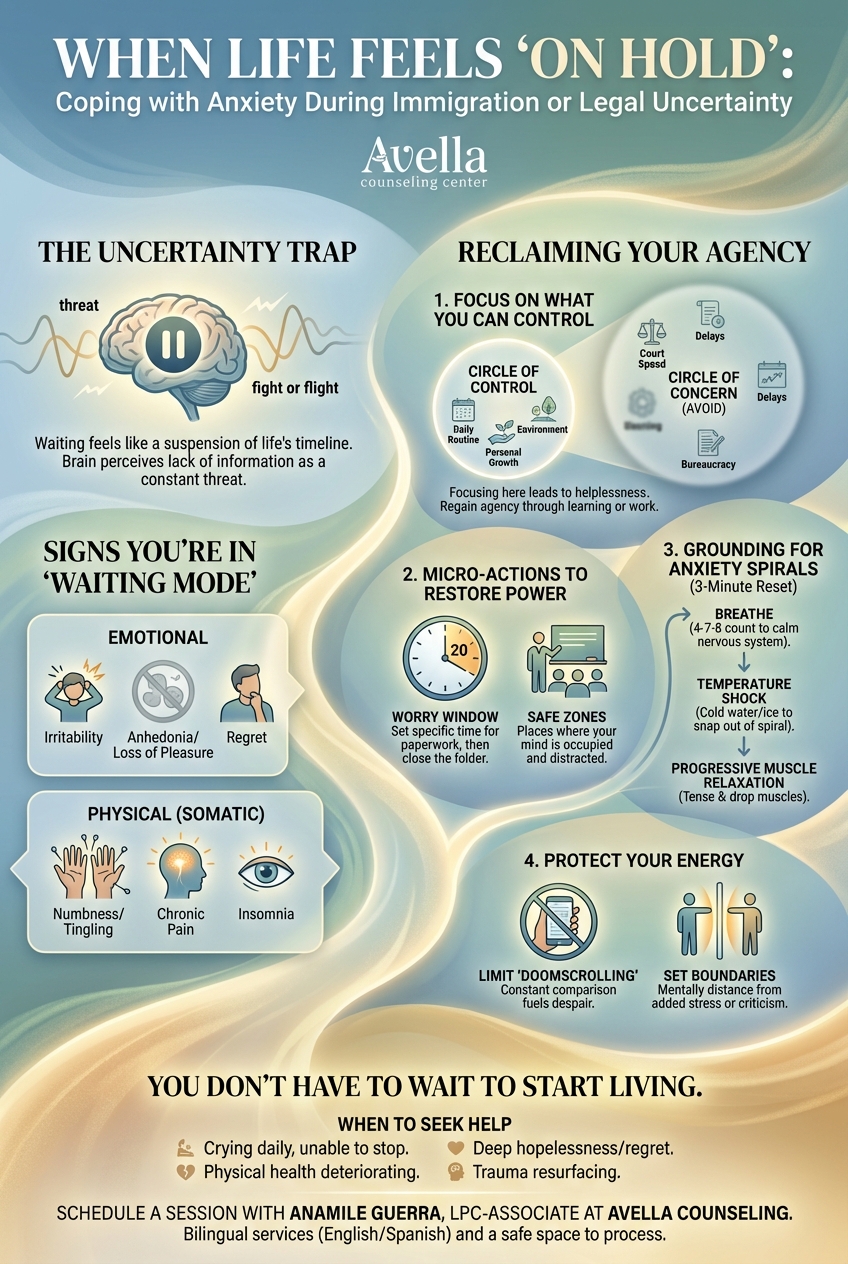
The Brain on ‘Pause’: Why Uncertainty Hits Harder Than Bad News
The human brain craves predictability. From an evolutionary standpoint, knowing what is coming next helps us stay safe. When you are in immigration limbo depression or legal uncertainty, your brain perceives that lack of information as a threat.
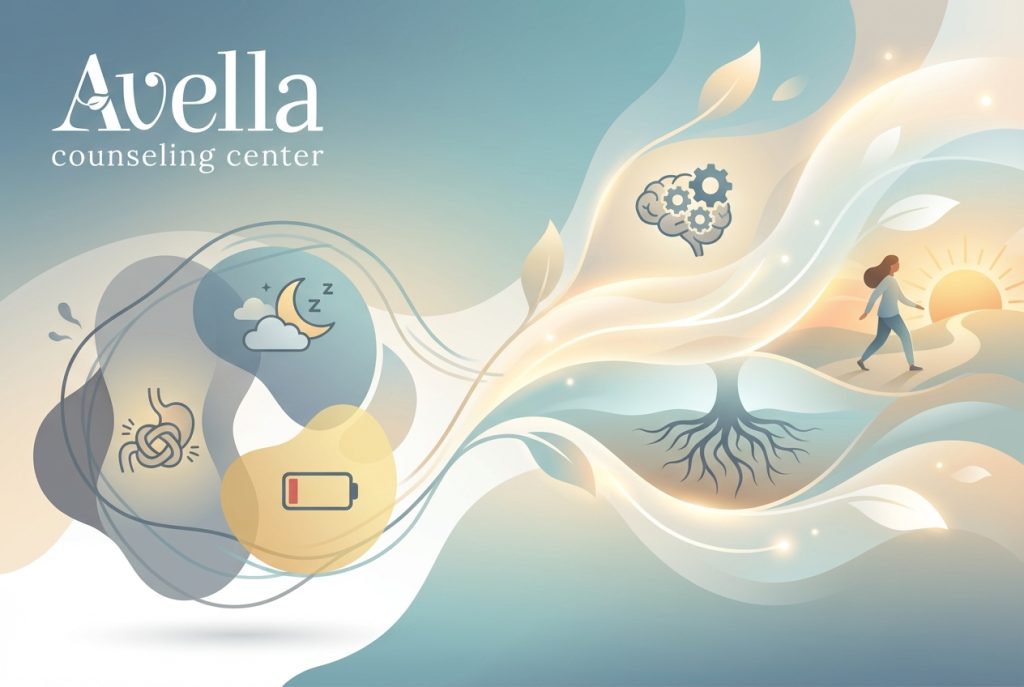
Because your brain is constantly scanning for danger (a rejection letter, a missed deadline, a negative phone call), your body often stays in a "fight or flight" mode. This isn't just "all in your head." It often shows up physically. You might experience tension headaches that won't go away, scalp sensitivity, or even numbness and tingling in your hands or arms. These are somatic symptoms of anxiety, signaling that your nervous system is overloaded.
According to the American Psychological Association, uncertainty intensifies stress because it requires your brain to constantly prepare for multiple outcomes, draining your energy reserves.
Signs Your Mind is in ‘Waiting Mode’
When you are waiting for legal status, it is easy to normalize suffering. However, recognizing the signs of legal fatigue and mental health strain is the first step toward feeling better.
Emotional and Behavioral Signs
- Irritability: You might find yourself snapping at your children for normal behavior, like playing too loudly or making a mess. When your internal stress bucket is full, you have no patience left for others.
- Anhedonia (Loss of Pleasure): You might stop caring about your appearance, struggle to find the motivation to dress up, or eat only because you have to, not because you enjoy the food.
- Regret: You may find yourself ruminating on the past, wondering if you made the right choice to move or wishing you could go back, even if your previous situation was unsafe.
Physical Manifestations
- Numbness and Tingling: Anxiety can cause hyperventilation (even subtle) or muscle tension that restricts blood flow, leading to hands or arms "falling asleep."
- Chronic Pain: Headaches, back pain, and hypersensitivity to touch (like hair brushing feeling painful) are common when the body is holding onto trauma and stress.
- Insomnia: You might be exhausted all day but unable to turn your brain off at night.
For more on how stress affects you physically, read about when anxiety shows up in your body.
Strategy 1: The ‘Two Circles’ Exercise
One of the most effective ways to manage coping with uncertainty and stress is to visualize two circles: the Circle of Control and the Circle of Concern.
- Circle of Concern (What you can't control): The speed of the courts, whether your lawyer calls you back today, the actions of an ex-partner, or bureaucratic delays. Focusing here leads to helplessness.
- Circle of Control (What you can control): Your daily routine, your immediate environment, how you treat your body, and your personal growth.
Try this: Even if your legal status is stalled, your personal growth doesn't have to be. Many people find relief by taking classes (like learning English or a new trade) or focusing on work. When you are learning or working, you are regaining agency. You are reminding yourself, "I am still building my future, even while I wait for the paperwork."
Strategy 2: Micro-Actions to Restore Agency
When you are waiting for a big decision, you can feel powerless. You can counter this by reclaiming power in small ways.
- The Paperwork Routine: Do not let legal stress bleed into your entire day. Set a specific "worry window"—perhaps 20 minutes in the morning—to check emails, call lawyers, or review documents. Once that time is up, close the folder and focus on the present.
- Create "Safe Zones": Identify places where you feel competent and distracted. For many, this is a workplace or a classroom. In these spaces, your mind is occupied with tasks, giving your "worry brain" a much-needed break. Healthy distraction can be a powerful tool for survival.
Strategy 3: Grounding Skills for Anxiety Spirals
If you feel sudden anxiety causing numbness and tingling, or if you feel a panic attack coming on, you need to bring your body back to safety.
The 3-Minute Reset
If you feel your hands shaking or your heart racing, stop what you are doing.
- Breathe: Inhale for 4 seconds, hold for 7, exhale for 8. This signals your parasympathetic nervous system to calm down.
- Temperature Shock: If you feel numb or dissociated, hold an ice cube or splash cold water on your face. The intense sensation can snap your brain out of the spiral and back into the room.
- Progressive Muscle Relaxation: Tense your shoulders up to your ears for 5 seconds, then drop them suddenly. Repeat this with your hands and feet.
The Anxiety and Depression Association of America (ADAA) notes that physical symptoms are often the first indicator of rising anxiety levels.
Strategy 4: Protecting Your Energy
Stress management for immigrants often involves setting boundaries, both with technology and people.
- Limit "Doomscrolling": It is tempting to spend hours on TikTok or Facebook watching videos about immigration laws or comparing your case to others. Remember, every case is different. Constant comparison often fuels despair rather than providing answers.
- Set Boundaries: If you are living with family members who add to your stress or criticize your parenting, it is okay to mentally distance yourself even if you cannot physically leave yet. You can say, "I am doing my best with the situation I have," and disengage from the conflict. Learn more about setting boundaries without guilt.
When to Seek Professional Support
There is a difference between situational stress and a mental health crisis. You may want to consider counseling if:
- You are crying daily and unable to stop.
- Your physical health is deteriorating (hair loss, chronic headaches, fainting).
- You feel a deep sense of regret or hopelessness that doesn't go away.
- Past trauma (such as domestic violence) is resurfacing during the waiting period.
Organizations like NAMI (National Alliance on Mental Illness) emphasize that cultural and legal stressors are valid reasons to seek professional mental health support.
You Don't Have to Wait to Start Living
You do not have to wait for your papers to arrive to start living your life again. The wait is difficult, but you are resilient. If the uncertainty is affecting your health and relationships, we can help you find your footing.
Schedule a session with Anamile Guerra, LPC-Associate, at Avella Counseling today. I offer bilingual services (English/Spanish) and a safe space to process the weight of the wait.