

There is a specific, silent type of pain that comes with staring at your phone, waiting for a scheduled call that may or may not happen. When you are co-parenting in a high-conflict situation, dealing with a long-distance move, or facing restrictive gatekeeping by an ex-partner, the feeling of powerlessness can be overwhelming.
You might feel like your ability to be a parent is being held hostage by another adult’s whims. You prepare yourself, you make time, and when the phone doesn't ring—or when the call is cut short—the disappointment is crushing.
While you cannot control your co-parent’s behavior or the legal schedule, you can control your emotional response and the quality of the connection you build with your child. This guide explores high-conflict co-parenting strategies to help you manage the anxiety of the wait and make every moment count.
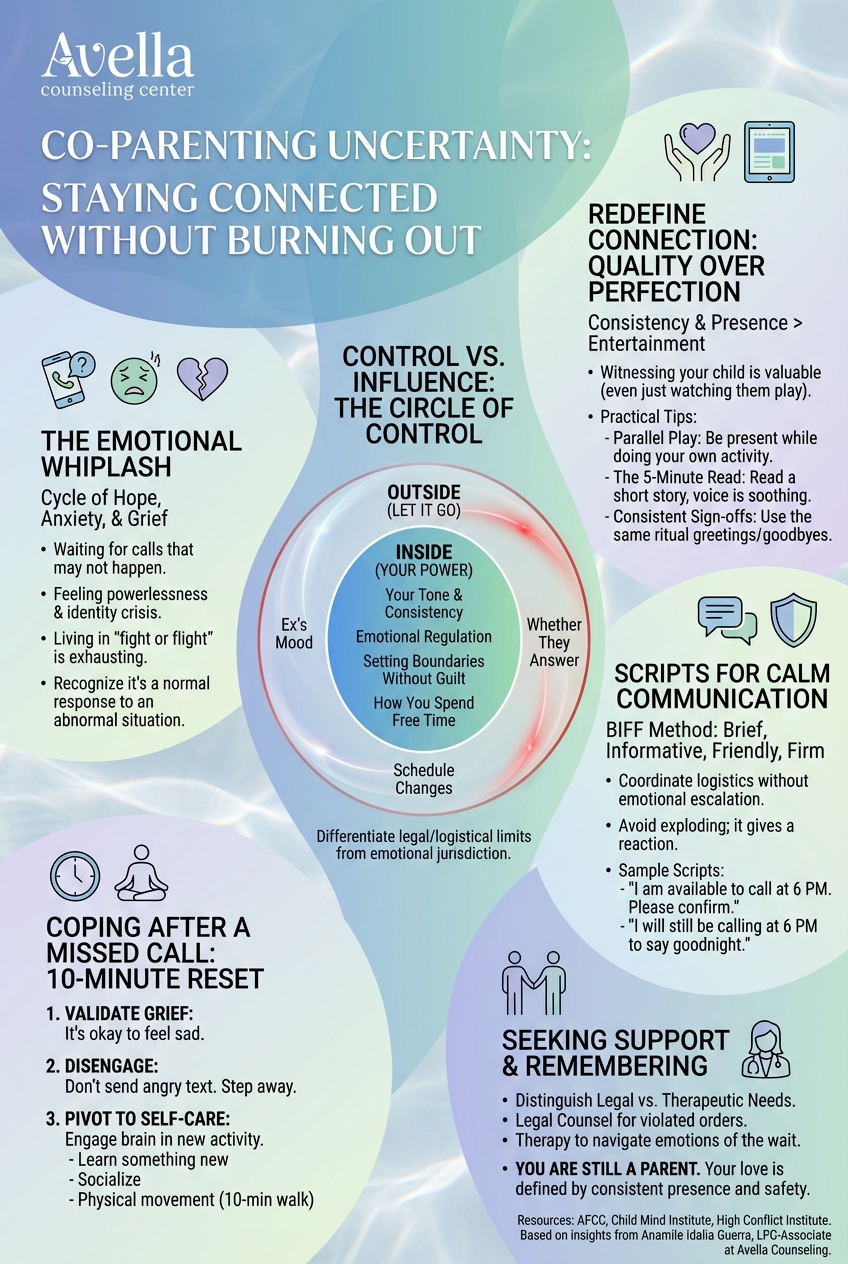
The Emotional Whiplash of Inconsistent Communication
The cycle often looks like this: You feel hope as the scheduled time approaches. Then, anxiety sets in—will they pick up? Will there be an argument? If the interaction fails to happen, you crash into grief and anger.
In therapy, we often hear parents describe this as a crisis of identity. When access to your child is threatened, it is normal to start questioning your entire future. You might find yourself asking, "Do I need a completely new life plan? What is my purpose if I can't be a dad or mom right now?"
Living in this state of "fight or flight" is exhausting. It drains the energy you need to actually be present when you do get that precious time. Recognizing that this "emotional whiplash" is a normal response to an abnormal situation is the first step toward regaining your balance.
Control vs. Influence: A Therapy Tool to Reduce Helplessness
One of the most effective ways to reduce anxiety is to differentiate between what is legally or logistically out of your hands versus what is within your "emotional jurisdiction."
Many parents exhaust themselves trying to force the other parent to cooperate. You might try reasoning with them, or even reaching out to their family members (in-laws) hoping they will intervene. often, this leads to a dead end. As painful as it is, realizing that certain channels—like unhelpful in-laws or arguing with an ex who won't listen—are ineffective can actually be a relief. It allows you to stop wasting energy on strategies that don't work.
Try the "Circle of Control" exercise:
- Inside the Circle (Your Power): Your tone of voice, your consistency, your emotional regulation, setting boundaries without guilt, and how you spend your free time.
- Outside the Circle (Let it Go): Your ex’s mood, their schedule changes, and whether they answer the phone on time.
Connection Over Perfection: Building Attachment from a Distance
When your time is limited, the pressure to make every interaction "perfect" can be paralyzing. You might feel like every video call needs to be a deep conversation or a fun event. However, research from the Child Mind Institute suggests that consistency and presence are far more important than entertainment.
Redefine what a "good" interaction looks like.
If your child is young or distracted, a 10-minute video call where you simply watch them play is valuable. You don't always need to force conversation. There is profound value in simply witnessing your child—seeing their face, hearing their voice, or even watching the ceiling fan spin while they run around the room.
Practical Tips for Remote Connection:
- Parallel Play: "I’m going to read my book while you play with your blocks. I’m right here on the screen."
- The 5-Minute Read: Read a short bedtime story, even if they seem wiggly. The sound of your voice is soothing.
- Consistent Sign-offs: Use the same greeting and goodbye every time to create a ritual of safety.
Scripts for Calm Communication (Boundaries Without Conflict)
Your goal in communication is to coordinate logistics without emotional escalation. High-conflict experts, like those at the High Conflict Institute, recommend the BIFF method: Brief, Informative, Friendly, and Firm.
It is difficult to remain calm when you ask a direct question about the future—like "When are you bringing him back?"—and receive silence. However, exploding via text usually gives a high-conflict co-parent exactly what they want: a reaction.
Sample Scripts:
- The "Just the Facts" Text: "I am available to call at 6 PM. Please confirm if this works."
- The Non-Engagement Response: If they send a long, accusatory paragraph, ignore the insults. Respond only to the logistics: "I see you are upset. I will still be calling at 6 PM to say goodnight to [Child's Name]."
For more on managing heated dynamics, read about how to de-escalate without losing your voice.
Coping After a Missed Call: A 10-Minute Reset Plan
The phone didn't ring. You waited, and now the window is closed. It is natural to feel a surge of rage or profound sadness.
Step 1: Validate the Grief.
It’s okay to feel sad. A missed call is a small loss that triggers the bigger grief of the separation. See our guide on coping with delayed grief.
Step 2: Disengage.
Do not send the angry text immediately. Put the phone in another room.
Step 3: Pivot to a Self-Care Activity.
Sitting and ruminating will increase your anxiety. Engage your brain in something new. This isn't just about distraction; it's about proving to yourself that your life continues.
- Learn something new: Take a professional training course or learn a new skill.
- Socialize: Meet new people or join a community group.
- Physical movement: A 10-minute walk can help process the adrenaline of the "fight or flight" response.
Finding joy in your own life—independent of your child—actually makes you a stronger parent when you do reconnect.
When to Seek Additional Support
It is important to distinguish between legal needs and therapeutic needs.
- Legal Counsel: If your court orders are being consistently violated, you may need to speak with an attorney about formalizing custody arrangements. Relying on verbal "gentleman's agreements" with a high-conflict ex is often unsustainable.
- Therapeutic Support: Therapy cannot change your custody order, but it can help you navigate the emotions of the wait.
The Association of Family and Conciliation Courts (AFCC) offers resources that help distinguish between legal disputes and family dynamic issues.
If you find that your anxiety about co-parenting is affecting your job performance, your sleep, or leading to physical signs of anxiety, professional counseling may be beneficial.
You Are Still a Parent
Even from a distance, and even with interruptions, you are still a parent. Your love for your child is not defined by the number of minutes you spend on a video call, but by the consistency of your presence and the safety you provide when you are connected.
If the stress of high-conflict co-parenting is impacting your daily life, you don't have to navigate it alone.
Anamile Idalia Guerra, LPC-Associate
Supervised by Jennifer Gonzalez, MS, LPC-S and Amanda Varnon, MA, LPC-S
Anamile is a bilingual therapist at Avella Counseling who understands the complexities of family dynamics, anxiety, and life transitions. She offers a supportive space to process the grief of separation and build practical strategies for the future.
Contact Avella Counseling today to schedule a consultation with Anamile.